Plans, Seats and What Each Plan Includes
QAM Hub has two paid plans, Standard and Advanced. Both are billed per seat, in EUR or USD, monthly or annually, and both include every AI feature in the product. Standard covers the full day-to-day workflow: suites, cases, checklists, runs, requirements, automation reports, dashboards, portfolio health and issue creation in your bug tracker. Advanced adds the analytical and governance layer on top: two-way tracker sync, Quality and Coverage Analytics, Release Readiness, scheduled email reports, organization audit logs, Google SSO, organization-wide 2FA enforcement, the knowledge base for AI context, priority support, and AI Testing Agents when they ship.
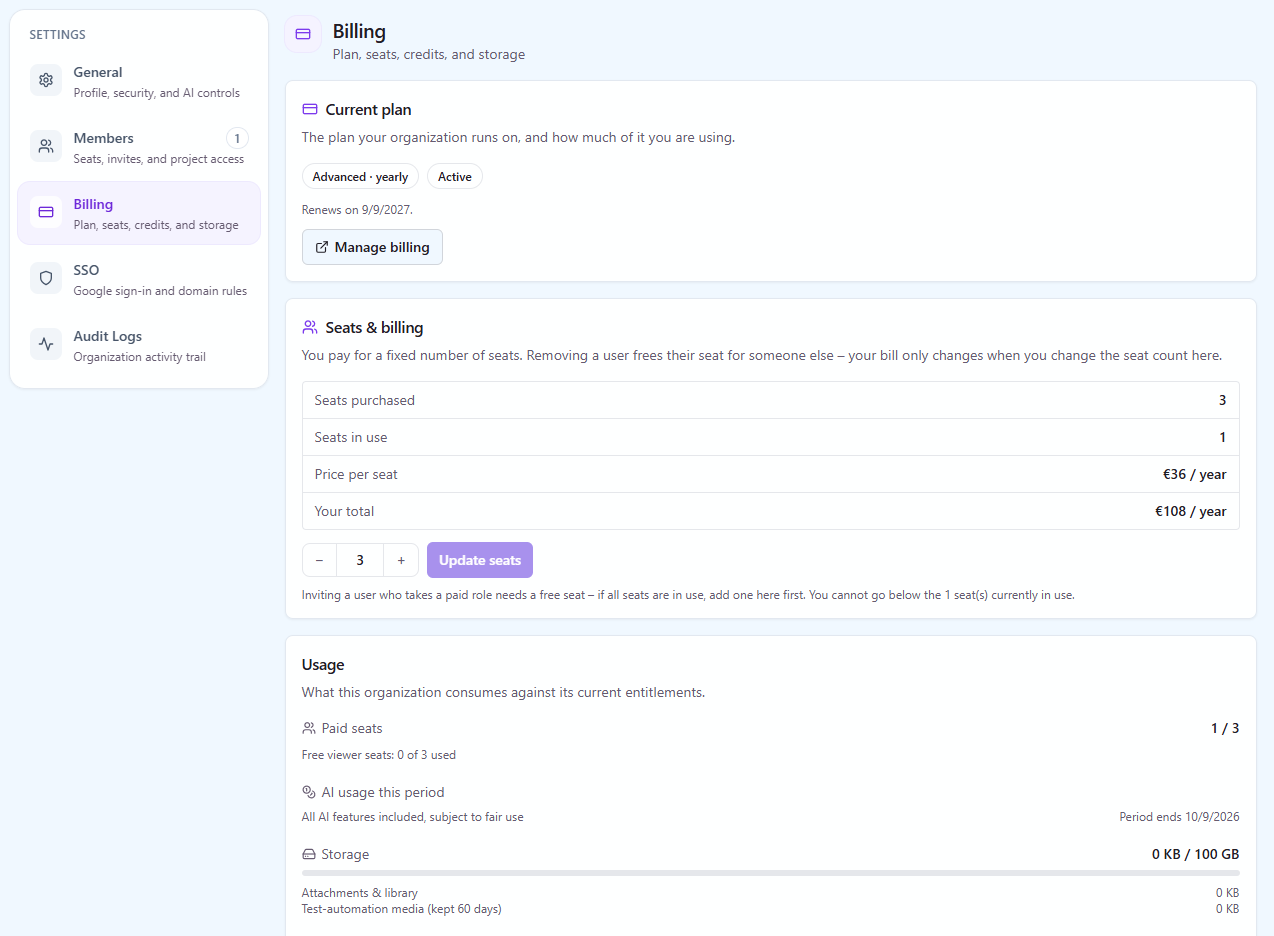
As of 9 September 2026 Standard is €24 per seat per month billed monthly, or €21 per seat per month billed annually. Advanced is €39 monthly, or €36 per seat per month billed annually. In dollars that is $27 and $24 for Standard, $45 and $42 for Advanced. Annual billing works out around 10% cheaper per seat and is charged once for the year. The pricing page is the current source for these figures.
What a seat is#
A seat is one person who can create or change something: test cases, checklists, runs, requirements, reports, settings. You pay for those people. Every paid seat also entitles you to one free viewer seat, at a ratio of one to one, so a workspace with ten paid seats can add ten viewers at no extra cost. Viewers can read everything they have project access to and cannot edit.
Viewer seats are the right place for the people who consume test results rather than produce them: product managers, developers who only need to see what failed, a client-side stakeholder on a shared project. If you need eleven viewers on ten paid seats, the eleventh needs a paid seat.
Seats are counted per organization, not per project. Roles are what limit access inside a project. If you are deciding who gets which role before you decide how many seats to buy, read Understanding Roles and Permissions first.
What each plan includes#
| Capability | Standard | Advanced |
|---|---|---|
| Test suites, cases, steps, templates, custom fields, tags, version history | Yes | Yes |
| Checklists with custom columns, run history and per-cell change history | Yes | Yes |
| Test runs, assignment, attachments, execution history | Yes | Yes |
| Requirements, traceability, milestones | Yes | Yes |
| Projects and test cases | Unlimited | Unlimited |
| Playwright and Cypress report import, generic XML ingest | Yes | Yes |
| Bug tracker issue creation (Jira, GitHub, GitLab, Linear) | Yes | Yes |
| Two-way tracker sync: status sync back from the tracker, traceability published into Jira, test cases mirrored as GitHub issues | No | Yes |
| AI test case and checklist generation, AI bug analysis and test-case fixes | Yes | Yes |
| In-app AI assistant | Yes | Yes |
| API tokens and MCP server for AI agents | Yes | Yes |
| Knowledge base for AI context | No | Yes |
| AI Testing Agents (Agent Flows) | No | Coming soon |
| Project dashboards, trend widgets, portfolio health across projects | Yes | Yes |
| Reports, PDF and CSV export, saved report setups, organization-wide cross-project reports | Yes | Yes |
| Scheduled email reports | No | Yes |
| Quality and coverage analytics | No | Yes |
| Release Readiness analysis | No | Yes |
| Role-based access, personal two-factor authentication | Yes | Yes |
| Organization-wide 2FA enforcement, Google SSO, organization audit logs | No | Yes |
| Free viewer seats, one per paid seat | Yes | Yes |
| TestRail import wizard | Self-service | Assisted |
| Support | Email within one business day | Priority, two business hours |
| Onboarding and team training session | No | Yes |
| Custom features on request | No | Yes |
Storage and retention#
Storage scales with the number of paid seats and has a floor, so a small team is not penalised for being small. Standard gives 10 GB per paid seat with a 25 GB minimum for the organization. Advanced gives 25 GB per paid seat with a 100 GB minimum. Storage is pooled across the organization rather than allocated per person.
One distinction matters more than the numbers. Videos and traces from uploaded Playwright reports are removed automatically once they pass the plan's retention window: 30 days on Standard, 60 days on Advanced. Nothing else is. Screenshots, attachments people add by hand during a run, assets in the image library and knowledge documents stay as long as the project does. If your compliance requirement is about evidence attached to a run, that evidence is not on a timer. If it is about the video of an automated run from last quarter, it is.
When an organization reaches its storage cap, nothing is deleted. New uploads are refused and a banner explains why, so the fix is to free space or add seats.
Which plan to start on#
Standard is enough if your team writes and runs tests, imports automation results, and files bugs in Jira, GitHub, GitLab or Linear. That is most teams, and it is not a stripped-down plan: AI generation, the in-app assistant, MCP access, portfolio health, the full reporting set and the TestRail import wizard are all in it.
Advanced earns the difference in three situations. The first is a team that wants the tracker updated automatically rather than manually: status sync back from the tracker, traceability published into Jira, test cases mirrored as GitHub issues. The second is anyone who needs to answer "can we release" with something better than a gut call, which is Release Readiness plus quality and coverage analytics. The third is an organization with a security or audit requirement, since SSO, enforced 2FA and audit logs are all Advanced. Migration help and a live onboarding session come with it, which matters most in the first month rather than the twelfth.
You do not have to decide on day one. Every new workspace runs on a 30-day trial of Advanced with no card, so you can use the Advanced features and then choose. See What Happens When Your Trial Ends for what changes at the end of it.
Where to check your current plan#
Open your organization settings and go to the billing area. The Organization Owner sees the active plan, the interval, the number of paid seats and the invoice history. Other roles do not: billing is Owner-only by design, and that includes reading it.