

Quality Analyzer
Finds duplicate, vague and incomplete test cases across a suite, grades it, and tracks what you fixed.
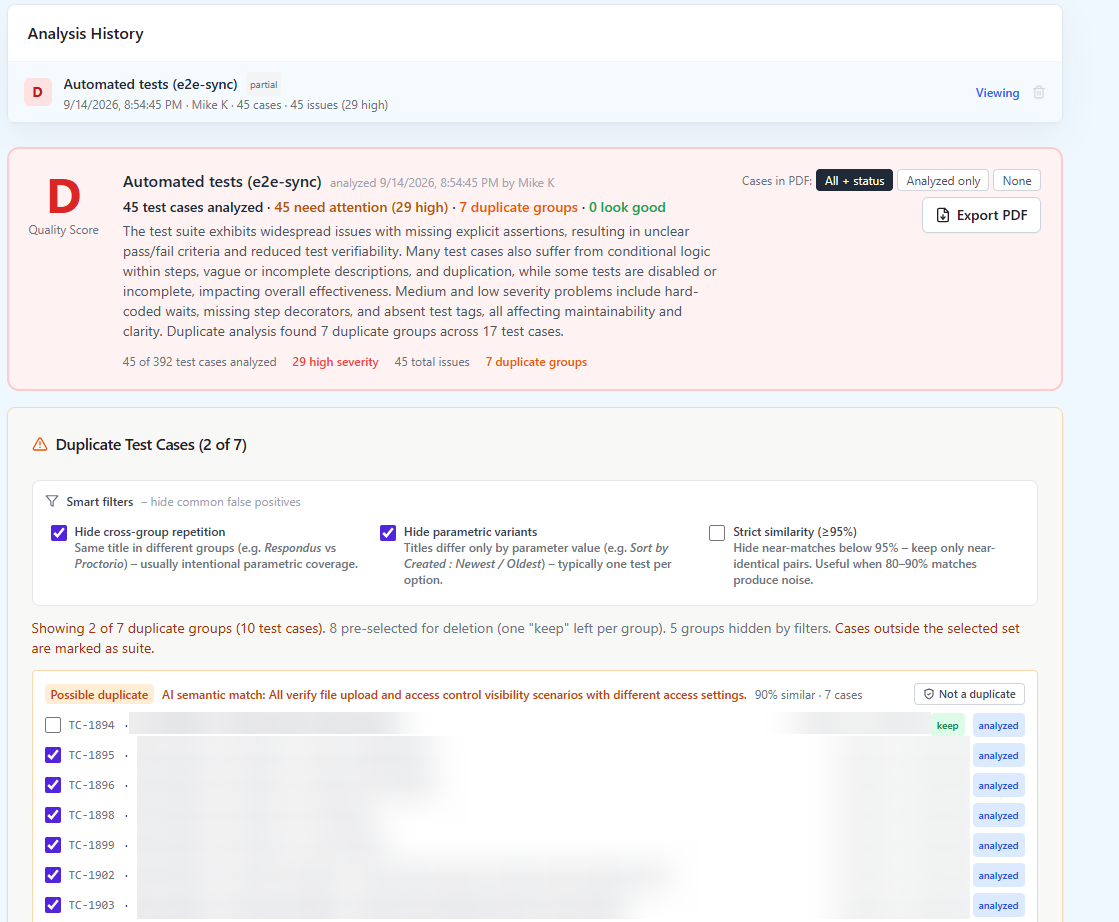
A test base rots quietly. The same scenario gets written three times by three people. A case has steps but no expected result, so it passes whatever happens. Another says "verify it works" and means something different to every tester. The Quality Analyzer reads a suite the way a careful reviewer would, and comes back with a grade, a list of findings with the exact text that triggered each one, and the duplicate groups you should collapse.
What it finds
- Missing or implicit expected results, so the case cannot actually fail.
- Vague or incomplete steps, conditional logic inside a step, hard-coded waits, disabled or half-written cases.
- Duplicates: near-identical titles and steps, and semantic duplicates that a text comparison would miss.
- Custom field problems: an empty required field, a dropdown value outside the allowed options, a non-numeric number. Each field's own description is used as context.
Every finding carries a severity, a verbatim evidence quote from the case and a suggested fix, so nobody has to open forty cases to understand what the report means.
How a run works
Pick a suite, or a selection of cases, and start the analysis from Reports → Quality. It runs in the background in batches with live progress, and the result is saved: close the tab, come back, open it from the Analysis History card without spending anything again. Credits are charged once, when the run completes; a run that fails costs nothing.
The grade is arithmetic, not opinion
The A to D score is derived from the distribution of findings by severity, never asked of the model. The same suite in the same state always gets the same grade, which is what makes it usable as a target. Each run is compared with the previous completed run of the same suite, over the cases both of them analyzed: "5 resolved, 2 new" is a measurable week of cleanup.
Duplicates you can act on
- Lexical groups and AI-found semantic suspects are merged into one list, with the similarity shown.
- Smart filters hide the usual false positives: the same title repeated across groups on purpose, variants that differ only by a parameter value, or anything below a strict 95% match.
- Each group pre-selects everything but one case to keep; you review, adjust and delete in one action.
- "Not a duplicate" is remembered per pair, so a legitimate pair never comes back in the next run.
Triage that sticks
Mark a finding Fixed or Dismissed, or reopen it. "Fix with AI" rewrites the case and marks the finding fixed in one step. A progress chip shows how much of the run is resolved, dismissed findings stay out of the PDF, and every analyzed case carries a team-shared "checked" marker in the suite, so two people do not review the same cases twice.
Export
The PDF carries the grade, the summary, the duplicate groups and the findings, with a choice of which cases to list: every case with its status, only the analyzed ones, or none for a short stakeholder version.
Where it fits
The Quality Analyzer is part of the Advanced plan and of every free trial, which runs on the full product. It uses the platform's AI, so there is no key to configure. A good rhythm is one run per suite before a release and one after a round of AI-generated cases: generation gets you volume fast, and the analyzer is how you keep the volume honest.