

Integrations & API
Each project connects its own issue tracker and creates or links issues from a failing execution. Status flows back into Jira and GitHub, and everything the interface does is an API call available to your scripts, CI and MCP-capable AI agents.
MCP server for AI agents
Manage suites, cases, runs and checklists from Claude or another AI agent over the Model Context Protocol.
QAM Hub exposes its test management API as MCP tools, so an AI coding agent can read your suites, create cases, open a run and record results as part of a larger task – reviewing a pull request and adding the coverage it implies, for example.
Access uses ordinary API tokens and the same role checks as the UI, so an agent can never do more than the user it acts for. Available to QAM Hub users on request.
- Read and write suites, cases, runs, checklists and requirements
- Authenticated with scoped API tokens, subject to the same roles
- Works with Claude and other MCP-capable agents
- Available on request
Issue tracker integrations
Connect Jira, GitHub Issues, GitLab or Linear once, then create and link issues without leaving a test run.
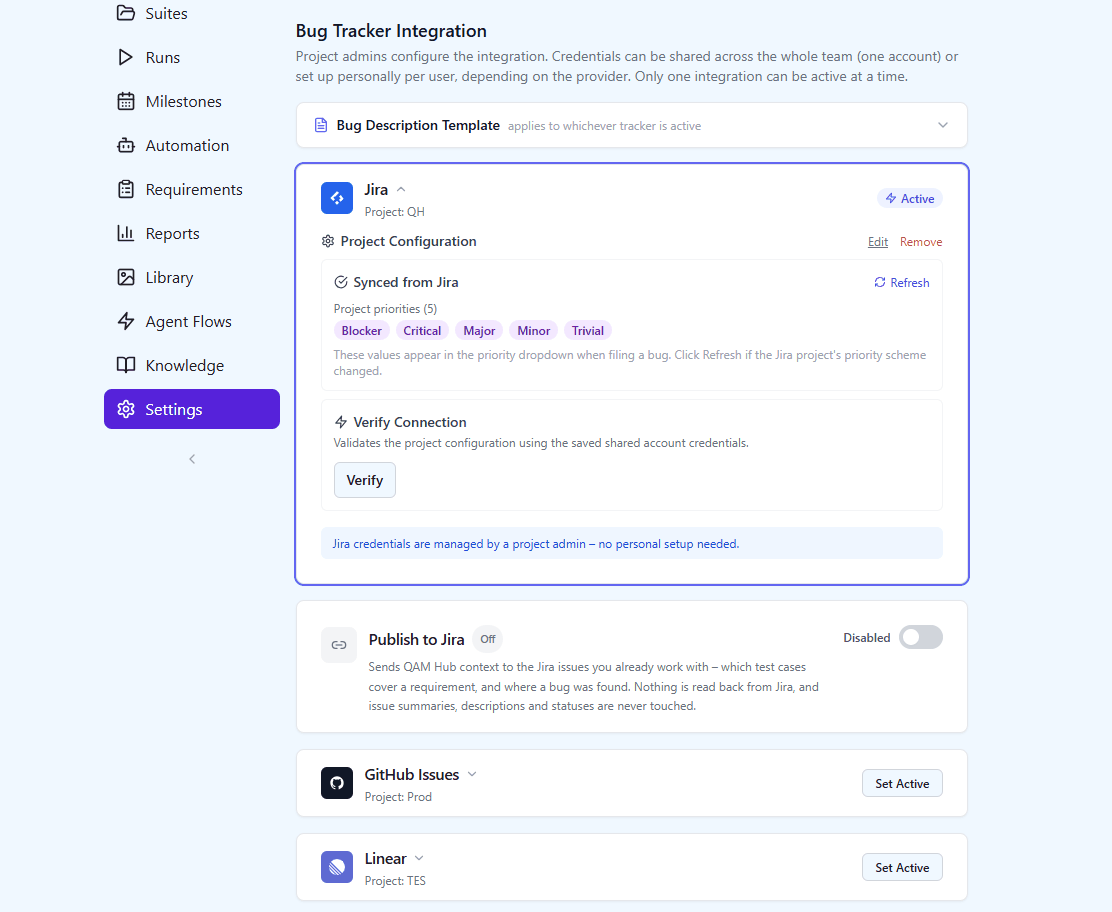
Each project connects its own tracker with encrypted credentials and its own field defaults. From then on, creating an issue is part of executing a test: the dialog is pre-filled from the failing execution, and the resulting issue is linked back to the case, the run and the requirement.
Providers sit behind a common interface, so the workflow is identical whichever tracker you use, and adding another one does not change how the product behaves.
- Jira, GitHub Issues, GitLab and Linear
- Per-project configuration with encrypted credentials
- Create from a failure, or link an issue that already exists
- Test the connection before you rely on it
Two-way sync & publishing
Push QA status back into Jira and GitHub, so people who never open a test tool still see the coverage.
Jira publishing adds a web link and a single, continuously edited QAM Hub comment to each linked issue: which cases cover this requirement, which defects were found, where the run stands. Nothing human-owned is overwritten, and nothing is pulled back without being asked for.
GitHub sync mirrors test status as labels on the matching issue, tracked by a stable marker rather than an issue number, so a reused number can never repoint a mirror at the wrong thing.
- Jira remote issue links plus one comment per issue, edited in place
- GitHub status-label sync with stable identity markers
- Opt-in per project, and off by default
- Failures surfaced in the integrations screen, never silent
REST API & API tokens
Everything the interface does is an API call, available to your own scripts through scoped API tokens.
The web app is a client of the same API your automation can use: suites, cases, runs, executions, checklists, requirements, milestones and reports. Tokens are issued per organization, carry the permissions of the user they belong to, and can be revoked.
That is what makes the CI reporters, the MCP server and any in-house tooling equal citizens – there is no privileged back door only the interface can reach.
- Scoped, revocable API tokens
- The same role and permission checks as the interface
- Google SSO for people, tokens for machines
- Every mutation recorded in the audit log