

Qase Alternatives: Which TMS Fits Your Team

If you are looking for a Qase alternative in 2026, the short answer is: pick QAM Hub if you want built-in AI that isn't metered by credits plus deep native automation reporting in one tool; TestRail if you need on-prem or heavy governance; Xray or Zephyr Scale if your team lives inside Jira; PractiTest if traceability and multi-tracker independence matter; and Tuskr or an open-source option (Kiwi TCMS, TestLink) if budget is the hard constraint. Most teams leave Qase for one of three reasons: AIDEN's credit system makes AI feel rationed, execution history and SSO sit behind add-ons, or the platform slows down and fragments runs under heavy CI load. This guide compares the realistic replacements, with current pricing and capabilities verified for 2026, so you can match a tool to how your team actually tests.
Quick verdict: the best Qase alternatives in 2026
| Tool | Best for | AI model | Automation depth | Jira model |
|---|---|---|---|---|
| QAM Hub (Best Overall) | Teams that want built-in AI, native automation reporting, and checklists in one place | Built-in, not credit-metered | Deep (Playwright/Cypress reporters + generic XML) | Two-way connector (7 trackers) |
| TestRail | Governance, on-prem, structured manual QA at scale | Newer AI features, review-first | API/CI integrations (not native) | Connector |
| PractiTest | Traceability and multi-tracker independence | SmartFox, included in every plan | Connector-based | Connector (multi-tracker) |
| Xray | BDD teams already inside Jira | Newer, Jira-scoped | Framework integrations | Native (tests are Jira issues) |
| Zephyr Scale | Jira-native reporting at enterprise scale | Minimal | Framework integrations | Native |
| qTest (Tricentis) | Large, regulated enterprises | Tricentis AI Workspace | Strong, part of a wider suite | Connector |
| Testmo | Unified manual, exploratory, and automated in one dashboard | Limited | CI integrations | Connector |
| Tuskr | Budget-conscious teams | Basic AI | Integrations | Connector |
| Kiwi TCMS / TestLink | Self-hosted, zero-license setups | None | API only | Integration/manual |
Why teams look for a Qase alternative
Qase launched in 2018 as a cleaner, faster answer to legacy tools, and for straightforward manual test management it still does that job well. The reasons teams start shopping around are specific and mechanical, not vague dissatisfaction.
AIDEN's credit system makes AI feel rationed
Qase's AI layer, AIDEN, runs on a monthly credit allowance: the Startup plan includes 1,000 credits, Business 2,000, and Enterprise 4,000, according to Qase's own pricing and help-center documentation. Credits reset monthly and do not roll over, and any usage beyond the allowance is billed at $0.40 per credit. Because generating cases, converting manual tests to scripts, and cloud execution all draw from the same pool, teams end up deciding which test cases "deserve" AI attention. That rationing dynamic is the opposite of what most people want from an assistant that is supposed to remove grunt work.
History, SSO, and read-only seats sit behind add-ons
On the Startup plan, execution history defaults to 90 days, and older data disappears unless you buy the data-retention add-on, per PractiTest's pricing breakdown of Qase. Single sign-on (SAML 2.0) is a paid add-on on the Business plan, reported at around $4 per user per month and available only on annual billing. Read-only stakeholder seats are billed separately as well. None of these are dealbreakers on their own, but together they make the real monthly cost harder to predict than the headline per-user figure.
It slows down and fragments runs under heavy load
Reviewers repeatedly note that Qase can lag during high-volume test executions, which hurts teams running large regression suites. A more structural complaint: when tests are sharded across CI workers, each worker or shard can generate a separate test run, so results fragment across many runs and metrics become harder to aggregate into one view. For a team pushing thousands of automated tests through parallel CI, that fragmentation adds real maintenance overhead.
Customization and Jira sync hit limits
Teams with complex workflows often report that Qase's fields, statuses, and reporting feel constrained once suites get large, and some describe intermittent friction connecting to Jira (authentication errors that break automatic bug reporting even when credentials look correct). If your process is non-standard, you may spend time on workarounds.
Three categories of Qase alternative
Before comparing individual tools, it helps to know the shape of the market, because the first real decision is architectural rather than about features. Standalone tools (QAM Hub, TestRail, PractiTest, Testmo, qTest) run independently of your issue tracker and connect to it through an integration, which suits teams that want one test system regardless of what they use for tickets. Jira-native tools (Xray, Zephyr Scale) store test cases as Jira issues, so there is no second system to keep in sync, at the cost of being priced against your total Jira seat count rather than just the people who run tests. Open-source tools (Kiwi TCMS, TestLink) trade a subscription for self-hosting, which fits teams with the infrastructure to run another service but not the procurement appetite for a commercial contract. Decide which of those three you want before you weigh feature lists.
QAM Hub: best overall Qase alternative
QAM Hub is a test management system built by QA Madness, a QA outsourcing company with roughly 150 engineers, under a "by QA, for QA" design brief. It's the strongest all-round replacement for teams leaving Qase because it answers the three most common Qase complaints directly: the AI is built in rather than credit-metered, the automation reporting is native and consolidated instead of fragmented, and it adds first-class checklists that most test management tools lack.
Built-in AI, no credit meter
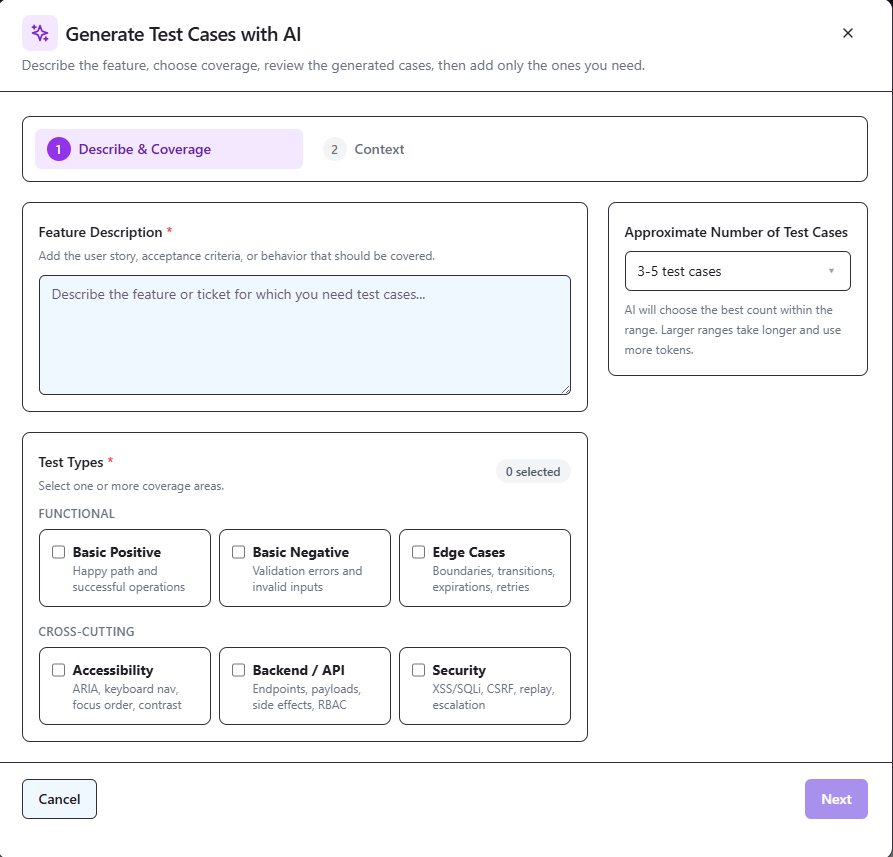
QAM Hub includes AI test-case and checklist generation (from a description or a screenshot), a Quality Analyzer that detects duplicate and vague test cases and suggests fixes, plus AI bug analysis, AI fix test, and AI retrospectives. The framing is deliberately human-in-the-loop: the agent proposes, a QA engineer decides. The practical difference from Qase is the billing model. There is no monthly credit pool to ration, so teams don't have to choose which cases get AI help. Fully autonomous AI Agent Flows, which drive test runs end to end, are rolling out soon and should be treated as an emerging capability rather than a shipped one.
Deep, consolidated automation reporting
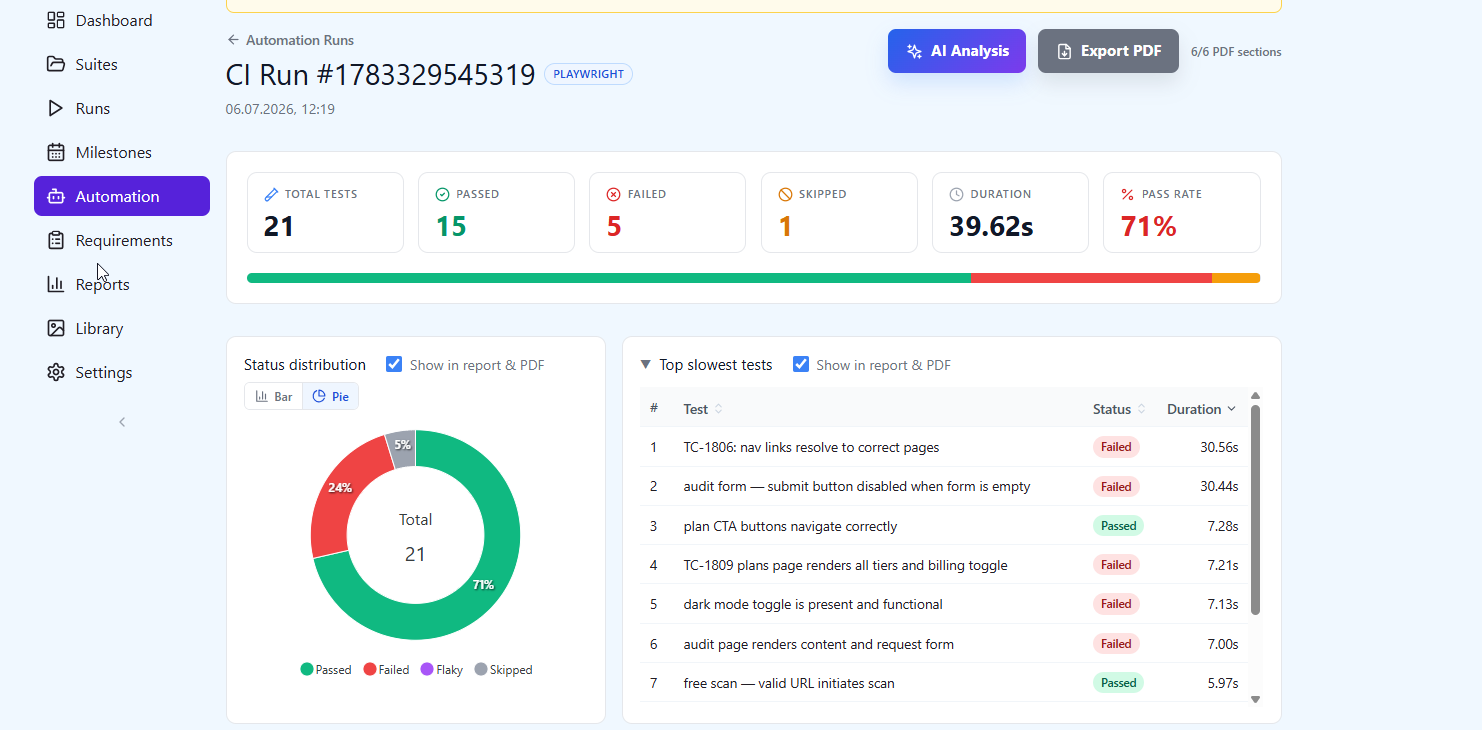
QAM Hub ingests results from Playwright and Cypress through official npm reporters, and from any other framework through a generic XML reporter, so you are not limited to two toolchains. It stores traces, video, and screenshots with each run, flags flaky tests, and surfaces analytics through a Test Explorer: pass rate, stability score, flakiness rate, average duration, and trends across a 7–90 day window. Cross-run intelligence highlights regressions (passed last run, failing now), chronic failures, and top failing tests, and admins can quarantine flaky tests. Automated results auto-link to the matching manual case via a TC-<number> prefix in the test title, and one automated test can cover several manual cases. CI metadata such as branch, commit SHA, and build URL is captured only when your pipeline passes it; a manual upload through the UI carries none, so nothing is implied that your pipeline didn't send.
Checklists, integrations, and a direct line to AI agents
Column-based checklist suites for release readiness and exploratory testing are a first-class feature here, which is unusual in this category. On integrations, QAM Hub offers two-way sync with seven issue trackers: Jira, GitHub Issues, GitLab, Asana, Linear, Redmine, and Trello, so you are not locked to a single tracker the way Jira-native tools require. For AI-forward teams, an MCP server lets agents such as Claude read and write test artifacts directly through the Model Context Protocol; it is currently available to QAM Hub users on request. API tokens are generated under Profile then API Tokens.
Reporting, customization, and migration off Qase
QAM Hub ships more than ten report types (coverage, traceability, release readiness, defects, team activity, and others) with PDF export, plus custom statuses, custom fields, and custom field types. Migrating from Qase is a CSV import of your test cases and the generic XML reporter for automation results, so you keep your structure rather than rebuilding it. Pricing is two straightforward per-user plans in the mid-market range, with no per-viewer charges, which removes the read-only-seat and add-on math that makes Qase budgeting fiddly.
Honest cons
Two caveats worth stating plainly. QAM Hub is a newer platform, so its community is smaller than decade-old incumbents like TestRail. And while it integrates with Jira through a two-way connector, it is not Jira-native (your tests don't live as Jira issues), so a team that wants everything inside Jira may prefer Xray or Zephyr Scale.
TestRail: for governance and on-prem
TestRail, owned by Idera since 2016, is the structured incumbent. It organizes cases into suites and sections with mature coverage and traceability reporting, and it can deploy on-cloud or on-premise, which matters for regulated teams. Current cloud list pricing is around $38 per user per month for Professional and roughly $71–74 for Enterprise, per TestRail's pricing page and G2 data; version control, approvals, SSO, and advanced auditing live only on Enterprise. TestRail has added AI features that auto-generate tests from user stories and let teams review suggestions before execution. The recurring criticisms are a dated interface, limited customization, slowdowns on large projects, and API rate limits that parallel test runs can hit. Choose TestRail if compliance, on-prem, and a familiar hierarchical model outweigh modern UX and native automation depth. See our TestRail alternatives guide for a deeper look.
PractiTest: for traceability and tracker independence
PractiTest is a full-lifecycle quality management platform built around requirements-to-test-to-defect traceability, with strong dashboards and connectors to multiple trackers rather than one. Its SmartFox AI is included in every plan with no usage credits, covering duplicate detection during test creation, step suggestions from user stories, and test-value scoring, which is a clean contrast to Qase's metered model. It sits at the heavier, more expensive end (commonly cited around $39–54 per user depending on tier and source, verify at purchase). Pick PractiTest if end-to-end traceability across several tools is the core requirement.
Xray and Zephyr Scale: for Jira-native teams
If your team already runs everything inside Jira, a Jira-native tool removes the second system entirely. Xray suits BDD teams and stores tests as Jira issues; Zephyr Scale is the reporting-heavy option at enterprise scale. The trade-off is pricing and reach: Jira-native apps are typically billed against your whole Jira user base, not just testers, which is the most common source of sticker shock, and you generally cannot use them outside Jira. Verify current per-user rates on the Atlassian Marketplace before committing, since both change and both depend on your Jira tier.
qTest, Testmo, Tuskr, and open source
qTest (Tricentis) targets large, regulated enterprises with a modular suite spanning case management, exploratory testing, analytics, and DevOps orchestration; Tricentis launched a centralized AI Workspace in March 2026. It is quote-based and carries a steeper learning curve. Testmo unifies manual, exploratory, and automated testing in one dashboard with predictable, mostly flat pricing, and suits teams that want that mix without enterprise overhead. Tuskr is the budget pick, with a genuinely usable free tier and low per-user rates. Open-source options like Kiwi TCMS and TestLink cost nothing to license but require you to self-host and accept dated interfaces and thinner support. Match these to a specific constraint (enterprise scale, unified execution, budget, or full control) rather than treating them as general-purpose swaps.
How to choose: a quick decision framework
- Choose QAM Hub if you want built-in AI without a credit meter, native Playwright/Cypress reporting plus a generic XML path, checklists, and two-way sync with several trackers, all in one tool.
- Choose TestRail if you need on-prem deployment, audit trails, and a structured model for large manual QA, and you can absorb the Enterprise-tier cost for governance features.
- Choose PractiTest if traceability across multiple issue trackers and included AI are non-negotiable.
- Choose Xray or Zephyr Scale if your team wants tests to live inside Jira and you accept Jira-seat-based pricing.
- Choose qTest for large regulated enterprises that need a modular suite.
- Choose Testmo for a unified manual, exploratory, and automated dashboard with flat pricing.
- Choose Tuskr or open source when budget is the hard limit.
Migrating off Qase without losing your suite
Whichever tool you land on, the migration mechanics are similar. Export your Qase test cases to CSV (Qase supports CSV and other export formats), then import them into the new tool, mapping fields and preserving suite structure. For automation, point your framework's reporter at the new system: with QAM Hub that means the Playwright or Cypress npm reporter, or the generic XML reporter for anything else. Keep both systems live in parallel for one release cycle so you can confirm coverage and reporting match before you switch off Qase. If your history matters for audits, export it before your Qase retention window (90 days on Startup unless you bought the add-on) closes.
Frequently asked questions
What is the best free Qase alternative?
For a genuinely free option, Tuskr's free tier and the open-source tools Kiwi TCMS and TestLink cost nothing to run, though the open-source ones require self-hosting and have dated interfaces. Qase's own free plan is capped at 3 users and 2 projects with 30-day history, so most teams outgrow it fast. If you want built-in AI and native automation reporting rather than the cheapest possible tool, a paid mid-market platform like QAM Hub is a better long-term fit than stretching a free tier.
Is Qase's AI (AIDEN) worth paying for?
AIDEN is capable: it generates cases from requirements, converts manual tests to Playwright, Cypress, or Selenium code, and executes them in a managed cloud. The catch is the credit model. Credits reset monthly, do not roll over, and overages cost $0.40 each, so heavy AI use gets expensive and needs monitoring. Tools that include AI in every plan without credits, such as QAM Hub or PractiTest, avoid that unpredictability.
Why do teams switch away from Qase as they grow?
The common triggers are performance under heavy CI load, fragmented runs when tests are sharded across workers, execution history and SSO gated behind add-ons, and customization limits for non-standard workflows. Small manual-first teams rarely hit these; larger automation-heavy teams do.
Which Qase alternative has the deepest automation support?
For teams whose priority is automated test reporting, QAM Hub consolidates Playwright and Cypress results (with traces, video, and flaky detection) and a generic XML path for any other framework into one Test Explorer with cross-run regression and flakiness analysis. Allure TestOps is another automation-first option if you run 100-plus frameworks, though it is weaker for manual-focused teams. See managing automated test results in a TMS.
Can I connect an AI agent like Claude to my test management tool?
Yes. QAM Hub provides an MCP server (available to users on request) that lets an agent read and write test artifacts directly through the Model Context Protocol, plus API tokens for scripted access. That fits teams building AI-assisted QA workflows. More detail in connecting Claude to your TMS via MCP.
What should I check before committing to any alternative?
Verify current per-user pricing and which features sit behind add-ons (SSO, data retention, read-only seats), confirm the automation reporter supports your framework, check history-retention limits against any audit needs, and run a one-release parallel trial before switching. For a broader shortlist, see our best test management tools in 2026.
The bottom line
Qase is a solid modern tool, and small manual-first teams may have no reason to leave it. Teams do leave when AI-by-credit, add-on gating, and load-related fragmentation start to cost more time and money than they save. If that's you, QAM Hub is the closest all-round upgrade: built-in AI with no credit meter, consolidated native automation reporting, checklists, and two-way sync with seven trackers, at two straightforward per-user plans. Match any tool to how your team actually tests rather than to a feature-count, and trial it against your real suite for a full release before you switch. If you are still deciding what a test management system should do at all, start with what is a test management system.
QAM Hub is built by QA Madness, who published this guide; competitor details reflect current public information at the time of writing and should be re-verified before purchase.