

Best Test Management Tools in 2026: Features, Pricing & Honest Comparison
Your test management tool is the operating system of your QA team — where test cases live, execution happens, and release decisions get made. In 2026 the best tools don't just store test cases: they generate them with AI, integrate deeply with your automation and trackers, and give real-time quality visibility. This guide compares the leading options with honest features, pricing, and a clear "who it's for."
We evaluated each tool across six dimensions: test case management, test execution, reporting and analytics, AI capabilities, integrations, and pricing and value.
Quick comparison at a glance
| Tool | Best for | AI | Automation depth | Pricing model |
|---|---|---|---|---|
| QAM Hub | Modern teams blending manual, automation & AI | Built-in (generation + quality analysis) | Deep: Playwright/Cypress + XML for any tool | Two per-user plans |
| TestRail | Structured testing at scale | Limited (Sembi IQ) | API + community reporters | ~$37/user/mo |
| Zephyr Scale | Jira-native teams | Limited | API | ~$10/Jira user/mo |
| Xray | Budget Jira / BDD teams | New (2026) | API + BDD | From ~$1/user/mo |
| Qase | Polished standalone UX | Yes (AIDEN credits) | API + CI/CD | From ~$24/user/mo |
| qTest | Large enterprise | Yes (Copilot) | API | ~$82/user/mo (quote) |
| PractiTest | Enterprise ALM & traceability | Yes (SmartFox) | API | ~$49/user/mo |
| Allure TestOps | Automation-first DevOps | Auto-updating cases | 100+ frameworks | ~$39/user/mo |
Pricing is approximate and reflects 2026 sources; vendors change plans often, so verify current pricing. For Jira-native tools, pricing usually applies to all Jira users, not just testers — a common source of unexpected cost.
How to choose the right tool
With this many strong options, the "best" tool depends on your situation. A quick framework:
Match your testing approach.
- Manual + automated + checklists in one place: QAM Hub
- Mostly automated: QAM Hub or Allure TestOps
- Mostly manual/scripted: QAM Hub, TestRail, or Qase
- Full lifecycle (requirements → testing → release): PractiTest or qTest
- Tests must live inside Jira: Zephyr Scale or Xray
Consider your toolchain. If your team lives entirely in Jira and won't leave, Zephyr Scale or Xray keep everything in one interface — but you pay for all Jira users, not just testers. If you use a mix of trackers and CI/CD, a standalone platform is more flexible: QAM Hub integrates two-way with Jira, GitHub Issues, GitLab, Asana, Linear, Redmine, and Trello.
Weigh AI seriously. AI-powered test generation and quality analysis are the biggest differentiators in 2026. QAM Hub builds AI into the core workflow — generation plus quality analysis that flags weak cases and suggests fixes — rather than metering it. Qase (AIDEN), PractiTest (SmartFox), and qTest (Copilot) also offer AI, often through credit-based systems, while Zephyr Scale has minimal AI and TestRail's remains limited.
1. QAM Hub — Best Overall for Modern QA Teams
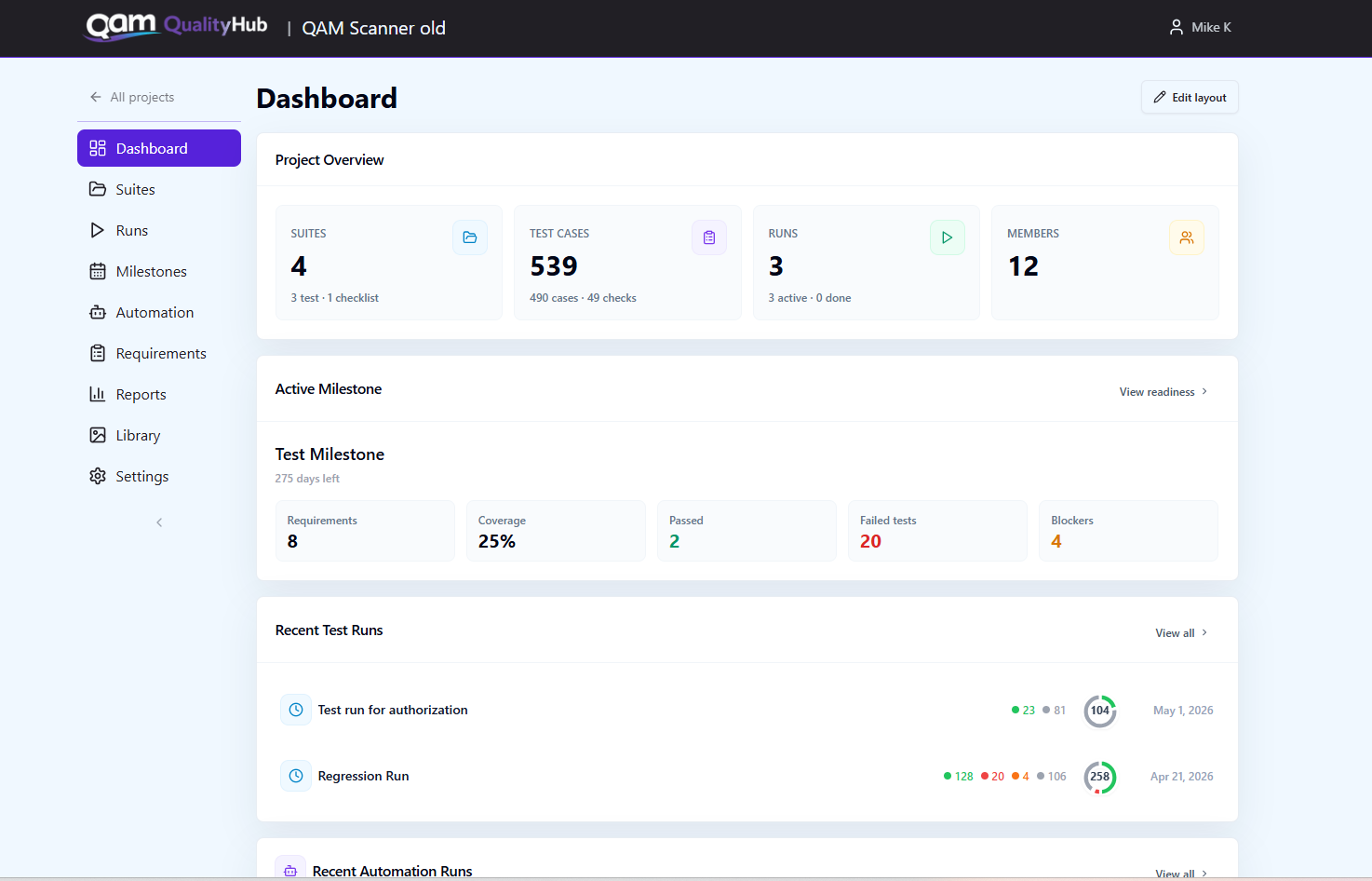
QAM Hub is a modern, standalone test management system built around the way QA teams actually work in 2026: manual testing, automated results, and checklists in one workspace, with AI woven into the core rather than bolted on. It's designed for teams that have outgrown spreadsheets or legacy tools and want automation depth and AI without enterprise complexity or per-Jira-user pricing.
Key features
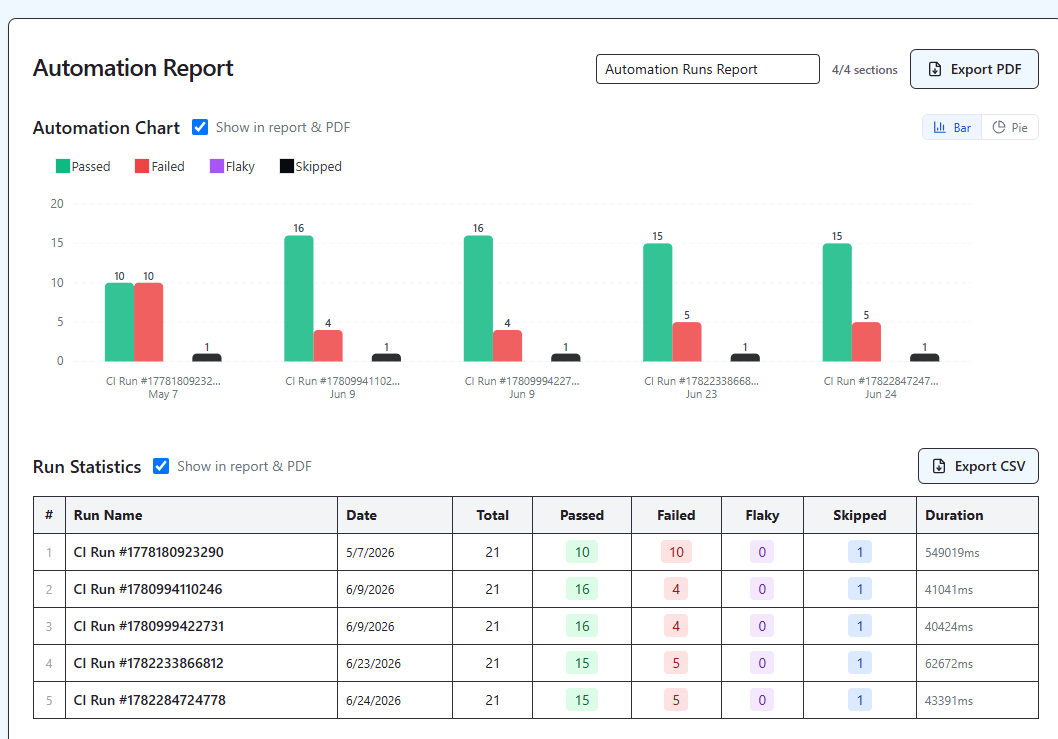
- Deep, broad automation integration. First-class Playwright and Cypress support via dedicated npm reporters — with traces, video, screenshots, flaky detection, and a Test Explorer showing pass rate, stability, and trends across runs — plus results from any other framework or tool through a generic XML reporter.
- Built-in AI. AI test-case generation, and AI quality analysis that detects duplicate and vague test cases and suggests fixes — built into the workflow, not metered as credits.
- First-class checklists. A lightweight checklist model alongside full test cases, which most TMS tools don't offer natively.
- Broad tracker integration. Two-way integration with Jira, GitHub Issues, GitLab, Asana, Linear, Redmine, and Trello.
- Deep customization. Custom statuses, custom fields, and custom field types to match your process.
- Detailed reporting and metrics across manual and automated coverage, with requirements traceability and release readiness.
- Programmatic & AI-agent access. API tokens plus an MCP server that lets AI agents like Claude manage test artifacts directly. AI Agent Flows — autonomous AI-driven test runs — are rolling out soon.
Pricing
QAM Hub keeps pricing simple with two straightforward per-user plans aimed at mid-market QA teams — no per-Jira-user surprises and no AI metered by the action. See current plans on the QAM Hub site.
Pros
- Deepest Playwright/Cypress insight in its class — traces, video, flakiness, and trends, not just result import
- AI built into the core (generation + quality analysis), not sold as credits
- Manual, automated, and checklist testing unified in one tool
- Seven two-way tracker integrations — fits whatever stack you already use
- Simple per-user pricing without per-Jira-user inflation
Cons
- A newer platform, so a smaller community than decade-old incumbents
- Integrates with Jira but is not Jira-native (tests don't live as Jira issues)
Bottom line: a capable choice for large, established QA teams that prize reporting, though premium pricing makes it harder to justify against fresher options. We compare nine TestRail alternatives with dated pricing if you are weighing a move.
2. TestRail — Best for Structured Testing at Scale
TestRail has been the industry standard for over a decade, with a polished runner and the deepest out-of-the-box reporting (70+ built-in reports). As of 2026 it holds around a 4.4 rating on G2.
Pricing: ~$37/user/month (Professional Cloud); no free tier.
Pros: mature and feature-complete for scripted testing; extensive reporting; on-premise option; large community.
Cons: limited AI (Sembi IQ); dated UI; expensive with no free tier; Jira via connector, not native.
Bottom line: a capable choice for large, established QA teams that prize reporting — but limited AI and premium pricing make it harder to justify against fresher options.
3. Zephyr Scale — Best for Jira-Native Teams
The leading Jira-native add-on (SmartBear): test cases are Jira-native objects, with strong traceability and no context-switching.
Pricing: from ~$10/user/month — but applies to all Jira users, not just testers.
Pros: seamless Jira experience; strong reporting and traceability; well-established in Atlassian.
Cons: charges per Jira user (costs multiply); requires Jira; minimal AI; reported performance issues on large projects.
Bottom line: the best option for teams that refuse to leave Jira — just do the math on per-Jira-user cost.
4. Xray — Most Affordable Jira Option
Also Jira-native, treating tests as Jira issue types, with strong BDD/Cucumber support and a cheaper entry point than Zephyr. AI test-script generation arrived in 2026 on higher tiers.
Pricing: from ~$1/user/month up to 10 users, then ~$6.33/user/month; applies to all Jira users.
Pros: very affordable entry; deep Jira integration; BDD support; broad automation-framework compatibility.
Cons: entirely dependent on Jira; UI can feel cluttered; complexity rises at scale.
Bottom line: the cheapest way to add test management to Jira, ideal for BDD-oriented development teams.
5. Qase — Best Standalone User Experience
A standalone platform praised for a clean, modern UI, with AI features via AIDEN credits and a solid integration ecosystem.
Pricing: Free (3 users, 2 projects); Startup ~$24/user/month; Business ~$30/user/month.
Pros: one of the best UIs in the category; AI via AIDEN; good API/webhooks; affordable read-only seats.
Cons: free tier limited to 2 projects; AI credits consumed per action; history retention limited on lower tiers.
Bottom line: a strong pick if UX is your top priority and you want a modern standalone tool with AI.
6. qTest (Tricentis) — Best for Large Enterprise
The enterprise heavyweight — built for hundreds of testers, complex compliance, and multi-team operations, with Copilot AI and 60+ metrics.
Pricing: quote-based, up to ~$82/user/month.
Pros: enterprise scalability and security; strong analytics; methodology-agnostic; modular.
Cons: expensive and opaque pricing; complex setup; overkill under 50 testers; heavy sales process.
Bottom line: right for large enterprises that need to scale to hundreds of testers; everyone else should look at more agile options.
7. PractiTest — Best for Enterprise ALM
A full ALM platform unifying requirements, test cases, and defects, with SmartFox AI and multi-bug-tracker support.
Pricing: Team ~$49/user/month; Corporate custom.
Pros: comprehensive lifecycle coverage; strong AI via SmartFox; connects to multiple trackers at once; great for compliance.
Cons: expensive; steeper learning curve; heavyweight for small teams.
Bottom line: the right choice for mid-to-large enterprises needing full lifecycle management and traceability.
8. Allure TestOps — Best for Automation-First Teams
Built for teams where automated tests are the backbone, with smart test cases that auto-update from run results and 100+ framework integrations.
Pricing: ~$39/user/month (1–30 users); self-hosted available.
Pros: best-in-class automation framework breadth; cases stay in sync with the codebase; strong CI/CD alignment.
Cons: expensive at small sizes; not built for manual-testing-focused teams; steeper learning curve.
Bottom line: the most automation-native option if your suite is overwhelmingly automated — though teams that blend manual and automated testing will find QAM Hub a better all-round fit.
Still using spreadsheets?
If your test cases live in Excel or Google Sheets, any tool here is an upgrade — the question is when to switch. The usual tipping points are 3+ testers, 200+ test cases, weekly releases, or any need for an audit trail. QAM Hub imports test cases directly from CSV, so you can move your existing sheets across without re-typing. See our deeper look at test management vs spreadsheets.
Frequently asked questions
What is the best test management tool in 2026?
For modern teams blending manual and automated testing with real AI, QAM Hub is the strongest all-round choice. TestRail leads on mature reporting, Zephyr Scale and Xray suit Jira-native teams, Qase offers the most polished standalone UX, qTest fits large enterprises, and PractiTest covers full ALM. The best fit depends on your automation reliance, Jira commitment, team size, and how much AI matters.
Should I pick a Jira-native tool or a standalone one?
If everything runs through Jira and you want tests to live as Jira issues, a Jira-native tool (Zephyr Scale, Xray) removes context-switching — but pricing usually applies to all Jira users, not just testers. If you use a mix of trackers and CI/CD, a standalone tool is more flexible; QAM Hub, for instance, integrates two-way with Jira, GitHub Issues, GitLab, Asana, Linear, Redmine, and Trello.
Which test management tools have the best AI features?
AI is the fastest-moving area in 2026. QAM Hub builds AI into the core (test-case generation and quality analysis), while Qase, PractiTest, and qTest offer AI often through credit-based systems, and some Jira-native tools have little or none. Trial AI on your own cases to judge quality, and check whether it's built in or metered.
How important is automation integration in a TMS?
Increasingly central. The difference is depth: many tools import results via API, while some go further with traces, video, screenshots, flaky-test detection, and trend analytics. If you run significant Playwright or Cypress suites — or want to feed other frameworks via a generic XML reporter — evaluate this closely. QAM Hub and Allure TestOps lead here.
Conclusion
The 2026 test management market is the most competitive it's ever been, with better pricing and AI that didn't exist two years ago. In short:
- Best overall for modern QA teams: QAM Hub — manual + automated + checklists, built-in AI, deep automation insight.
- Best for structured testing at scale: TestRail.
- Best for Jira teams: Zephyr Scale (richer) or Xray (cheaper).
- Best standalone UX: Qase.
- Best for large enterprise: qTest.
- Best for ALM: PractiTest.
- Best for automation-first teams: Allure TestOps.
The best tool is the one your team actually uses — start with a trial, import a subset of your cases, and evaluate on real usage over a sprint, not a feature checklist.
QAM Hub is built by QA Madness, who published this guide; competitor details reflect each vendor's current public information. For deeper dives, see our TestRail alternatives and Qase alternatives comparisons.