

Mapping Automated Test Results to Test Cases Without Breaking It
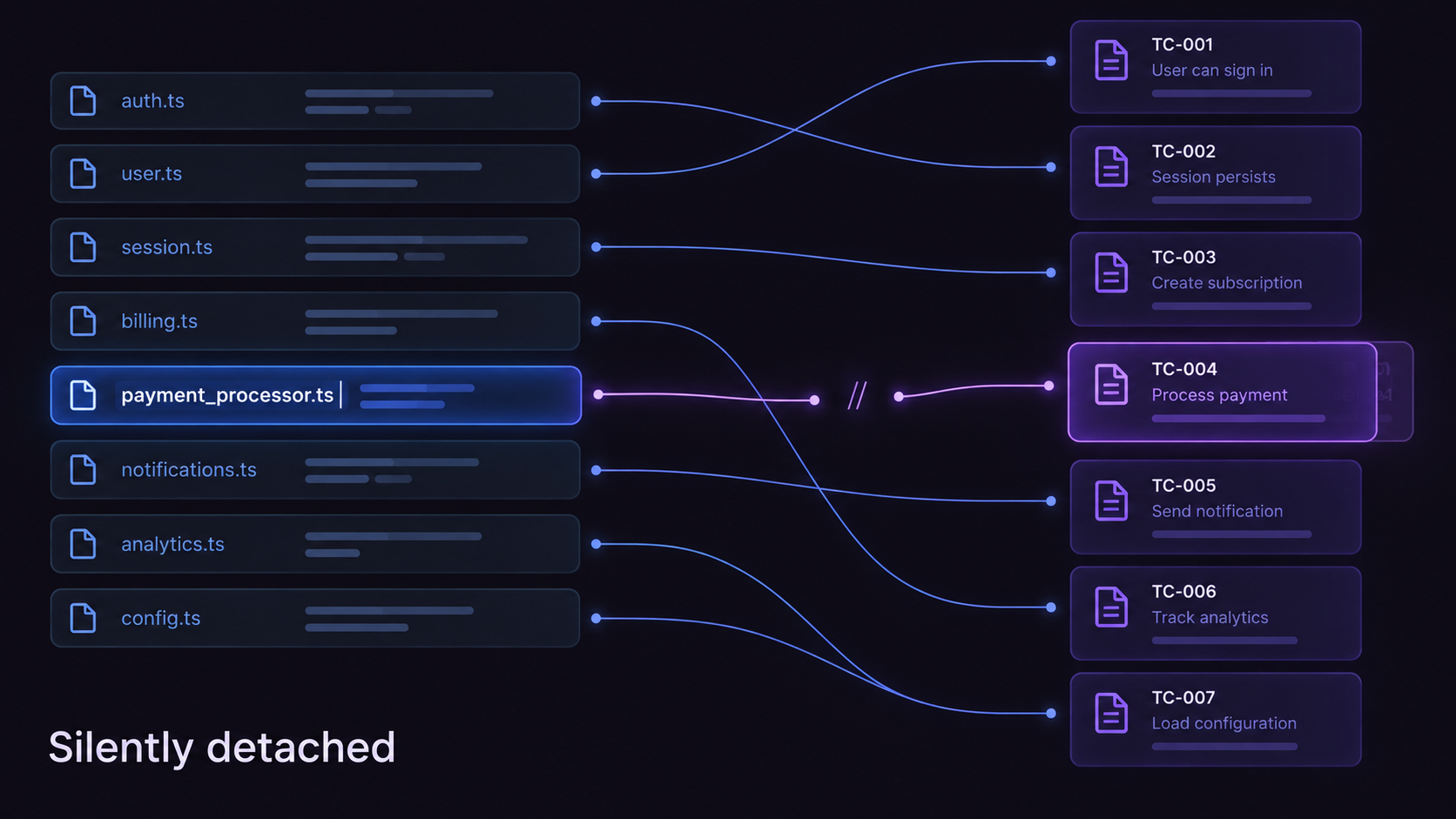
The link between an automated test and the test case it is supposed to prove is almost always a string, and nothing in the report format protects it. Rename the test, move it to another file, or add a parameter, and most test management systems will treat it as a test they have never seen: they either create a duplicate case or leave the result unattached. The run still goes green, the results still upload, and your coverage number quietly stops meaning what it meant last week. This is the most common silent failure in automated reporting, and it is worth understanding before you build reporting on top of it.
The format cannot help you, and that is the root of it
JUnit XML is the interchange format almost every runner emits or can be made to emit, and it has no field for a test's identity. A <testcase> element carries a classname and a name, a duration, and a child element if it failed. There is no ID, no stable key, no notion that this test corresponds to something documented elsewhere.
<testsuite name="checkout" tests="2" failures="1">
  <testcase classname="tests.checkout.CheckoutTests" name="applies_promo_code" time="1.842"/>
  <testcase classname="tests.checkout.CheckoutTests" name="rejects_expired_promo" time="0.914">
    <failure message="Expected 400, got 200"/>
  </testcase>
</testsuite>
Everything a test management system knows about those two tests is in those attributes. So every vendor invented a convention on top of the format, and the conventions do not agree with each other. That is why moving between tools breaks your mapping, and why a technique you learned on one tool quietly does nothing on the next.
What the tools actually do
Five approaches, read from vendor documentation in September 2026. They fall into three groups, and the group matters more than the vendor.
Derived from the test's own name
TestRail's code-first workflow builds what it calls an Automation ID by combining the two attributes the format gives it. Its documentation states that each case "is mapped using the automation_id field, which is automatically generated from the test class and name in the format: <classname>.<testname>". A test in tests.LoginTests called test_case_1 becomes tests.LoginTests.test_case_1.
Xray does the same thing under a different name. Its JUnit import documentation says the classname and name attributes "are concatenated and mapped to the Generic Test Definition field", and that "if no test issue id or key is specified and no test exists with the same generic test definition, then a new test will be created."
Allure derives three identifiers this way. Its fullName comes from package, class and test name; testCaseId is usually a hash of fullName; historyId adds the parameter values. All three change when the code moves.
This group costs nothing to adopt, which is why most teams are in it without having chosen it. It also breaks on the most ordinary engineering action there is. TestRail says so itself, in a warning on its own documentation page: "Renaming a test or moving its location in code will result in a new automation_id, which may create duplicates", under a heading that reads "Changes in test names or structure can lead to duplicate test cases."
Declared inside the test source
The second group puts the identifier in the code, where refactoring tools leave it alone.
Testmo reads a comment above the test function. Its CLI extension documentation describes linking as "adding special comments in your test source code", in the form @TestmoId:42, and states plainly that this "survives test name changes" because the link is to the annotation rather than to the executed test name.
Qase's Playwright reporter offers four shapes of the same idea: a wrapper around the title, test(qase(1, 'User can login'), ...); a call inside the body, qase.id(1); an array for a test that covers several cases, qase([1, 2, 3], ...); and a native Playwright annotation, { type: 'QaseID', description: '1' }, which the docs recommend when you want to avoid importing the reporter into test files at all.
Allure's answer is the ALLURE_ID label, and its documentation is explicit about why it exists: when the label is present "it overrides fullName as the main test case identifier for test plans, and it doesn't change when you rearrange your code in any way."
Declared outside the code
The third group keeps the identifier out of the source entirely. TestRail accepts it as a property on the XML element:
<testcase classname="tests.checkout.CheckoutTests" name="applies_promo_code">
  <property name="test_id" value="C4821"/>
</testcase>
Several IDs go in the same property, comma-separated, and the documentation is strict that they must be "comma-separated IDs without extra characters" and that every referenced case has to exist already. Testmo supports the same idea through a configuration file that maps test names to case IDs, for teams who cannot or will not put vendor annotations in their source.
Which of the three to pick
Declare the identifier in the test source unless you have a specific reason not to. It is the only option where the thing that breaks the link and the thing that fixes it are in the same file, in front of the person doing the refactor.
The argument against it is real and worth stating: an annotation puts a vendor's concept into your test code, and if you change tools you edit every test. Weigh that honestly against the alternative, which is that a name-derived link breaks on a rename and nobody finds out. A find-and-replace across a test suite during a tool migration is a bad afternoon. Discovering six months of detached coverage during a release review is a bad quarter.
Choose the out-of-band option in two situations. Your test code is shared across products or teams that do not all use the same test management system, so an annotation would mean something to only some of them. Or your organisation has a rule against third-party identifiers in application and test code, which is more common in regulated environments than vendors assume.
Stay with name-derived matching only when your suite is small enough that a human notices a new case appearing, or when the automated tests are not the basis of any coverage claim. Both of those are legitimate. Neither survives growth.
The failure modes, in the order they actually bite
These are not hypotheticals. Each one follows directly from the mechanics above.
A rename. Someone improves test_login to test_login_with_expired_password during review. The identifier changes. On the next run the system either creates a second case or, if it does not create cases automatically, records nothing against the original. Coverage for that behaviour shows as automated in one report and manual in the next, and no build fails.
A move. The class or package is part of the identifier in every name-derived scheme, so reorganising a test directory detaches every test in it at once. This is worse than a rename because it is bulk, and because directory reorganisation is exactly the kind of change reviewers wave through.
Parameterisation. Turning one test into a data-driven test with six cases produces six identifiers where there was one. Allure documents this directly: historyId depends on parameter values, so each combination is tracked separately. If your documented case is a single manual case, you now have six automated tests pointing at it, or six new ones pointing at nothing, depending on the tool.
Retries. A test that fails, retries and passes can arrive as two or three entries with the same name. Some importers count them as separate results and your pass rate becomes arithmetic about attempts rather than about tests. Check what your ingest does with pytest-rerunfailures or Jest retries before you trust a trend line.
Sharding. Splitting a suite across CI workers produces several report files. If each is uploaded as its own run, one logical execution appears as four partial ones, and per-case history fragments across them. Merge the files before upload, or use an ingest that merges them for you.
One test covering several cases. An end-to-end test that walks a checkout flow may prove five documented cases. Tools that accept only one ID per test force you to pick one and under-report the rest. TestRail's comma-separated property and Qase's array form exist for this, and if your tool has no equivalent, your coverage number is structurally low and you should say so rather than explain it away.
A deleted case. Someone removes an obsolete manual case. The automated test still runs and still reports, now against an ID that no longer resolves. Depending on the tool this is an error, a silently ignored result, or a new case created from the same ID. All three are bad in different ways.
Make the breakage loud
The technique that fixes this is not a better naming convention. It is treating an unmatched test as a build problem.
Every ingest knows, at upload time, how many tests in the report it could not attach to a known case. That number is the signal. If it is zero today and three tomorrow, three tests were renamed, moved or parameterised, and someone can look while the change is still fresh in their head. Left unwatched, the same three become a coverage report that nobody trusts and eventually nobody reads.
Testmo ships this as a CLI flag, --fail-on-unmatched, alongside a summary that reports how many tests are unlinked and suggests resolutions. Treat that as the pattern rather than as a feature of one product. If your tool does not offer the flag, the API almost certainly returns the unmatched count, and a five-line CI step that fails the job above a threshold is cheap.
Two practical notes on the threshold. Set it to zero on a mature suite, because on a mature suite any unmatched test is a real event. Set it to the current count on a suite you are still bringing under control, and ratchet it down, otherwise you will disable the check in a week.
A mapping policy that holds up
Four rules, in priority order. The first two do most of the work.
Put the identifier in the test source, next to the test. Whatever form your tool supports: an annotation, a decorator, a prefix in the title. Somewhere a reviewer will see it in the diff when they rename the test.
Fail CI on unmatched tests. One threshold, checked on every upload. This is the difference between a mapping that decays and one that does not.
Decide what an unmatched test means before it happens. Two defensible policies exist: automated tests may create cases, or they may not. Both work. Mixing them, which is what most teams do by accident, produces a case library where some entries are documented behaviour and others are the residue of a refactor, with nothing to tell them apart. If you do allow automatic creation, tag those cases so you can find them later.
Review the mapping when the suite is reorganised, not after. Directory restructuring, framework upgrades and parameterisation drives are the three changes that detach tests in bulk. Put a line in the review checklist for them; it costs a minute and saves the quarter-end argument.
What not to over-engineer: a custom ID registry, a naming standard enforced by a linter, or a nightly reconciliation job. Teams build all three, and all three are attempts to make a name-derived link behave like a declared one. Declaring it is cheaper.
How this works in QAM Hub, including the trade-off
QAM Hub links an automated test to its documented case through a TC-<number> prefix in the test title, and one automated test can be linked to several cases. By the taxonomy above that is a declared identifier living in the source, with the practical property that renaming the descriptive half of the title changes nothing. The honest limitation is the other half: the prefix is part of a string, so deleting it deletes the link, and nothing in your editor will stop someone doing that. The unmatched count is what catches it.
Results arrive through the Playwright and Cypress reporters published on npm, or as JUnit XML from anything else, which in the shipped parser covers pytest, Jest, Vitest, Mocha, TestNG, Surefire and Gradle, gotestsum, PHPUnit, RSpec, Robot, Newman and .NET. Framework detection is automatic and can be forced with a qam.framework property when a report is ambiguous. Several XML files from a sharded run merge into one report rather than arriving as separate runs. Retries collapse into one test with its attempts, so a flaky test does not inflate the count, while parameterised repeats stay separate because they are genuinely different executions. Traces, video and screenshots attach to the result, which matters here because an unattached result with evidence is at least investigable.
Two points worth naming rather than leaving to discovery. CI metadata is optional: branch, commit SHA, environment and build URL arrive only if your pipeline passes them, and a manual upload through the interface has none. And the XML parser rejects DOCTYPE and ENTITY declarations, which is the guard against XXE in an uploaded file and occasionally surprises someone whose generator emits a doctype.
If you are setting this up, the step-by-step is in the knowledge base for uploading Playwright reports and uploading Cypress reports, and the reporting side is in automation coverage reporting.
What good looks like
A suite with healthy mapping has three properties, and you can check all three in an afternoon.
Every automated test resolves to a case, or is deliberately excluded and the exclusion is recorded. The unmatched count is zero or a number someone owns. And the coverage figure moves only when someone writes or deletes a test, never when someone renames one. If your coverage number has ever moved for a reason nobody could explain, check the mapping before you check anything else.
The wider picture of what to do with results once they land, including how execution history turns into flakiness and stability reporting, is in managing automated test results in a TMS. For framework-specific setup, see test management for Playwright teams and test management for Cypress teams.
Frequently asked questions
Does JUnit XML support test case IDs?
Not natively. A <testcase> element carries classname, name, a duration and a failure child, and nothing else that identifies it. Tools that accept case IDs in JUnit XML read them from a <property> child element, which is a convention each vendor defines for itself rather than part of the format.
What is an automation ID?
A stable key that ties one automated test to one documented case. In tools that generate it for you, it is usually the test's class and name concatenated, which means it changes whenever the code moves. In tools where you declare it, it is a number or key you write into the test source or into the report, and it survives refactoring.
What happens when you rename an automated test?
With a name-derived identifier, the tool sees a test it does not recognise. Depending on the tool it creates a new case, leaves the result unattached, or both. TestRail's own documentation warns that renaming or moving a test produces a new automation ID and can create duplicates. With an identifier declared in the source or in the report, nothing happens, which is the point of declaring it.
How do you map one automated test to several test cases?
Most tools that support it take a list. TestRail accepts comma-separated IDs in a single property, Qase's reporters accept an array, and QAM Hub allows one automated test to link to several cases. If your tool takes only one ID, an end-to-end test that proves five documented behaviours can only be credited to one of them, and your coverage figure will read low for a structural reason rather than a real one.
Why does coverage change when nobody wrote a test?
Almost always a detached mapping. A rename, a directory move or a parameterisation drive changed the identifiers, and the results that used to land on existing cases now land on new ones or nowhere. Compare the unmatched count between the two runs before looking anywhere else.