

Autonomous Regression Testing with AI Agents: What Actually Works in 2026
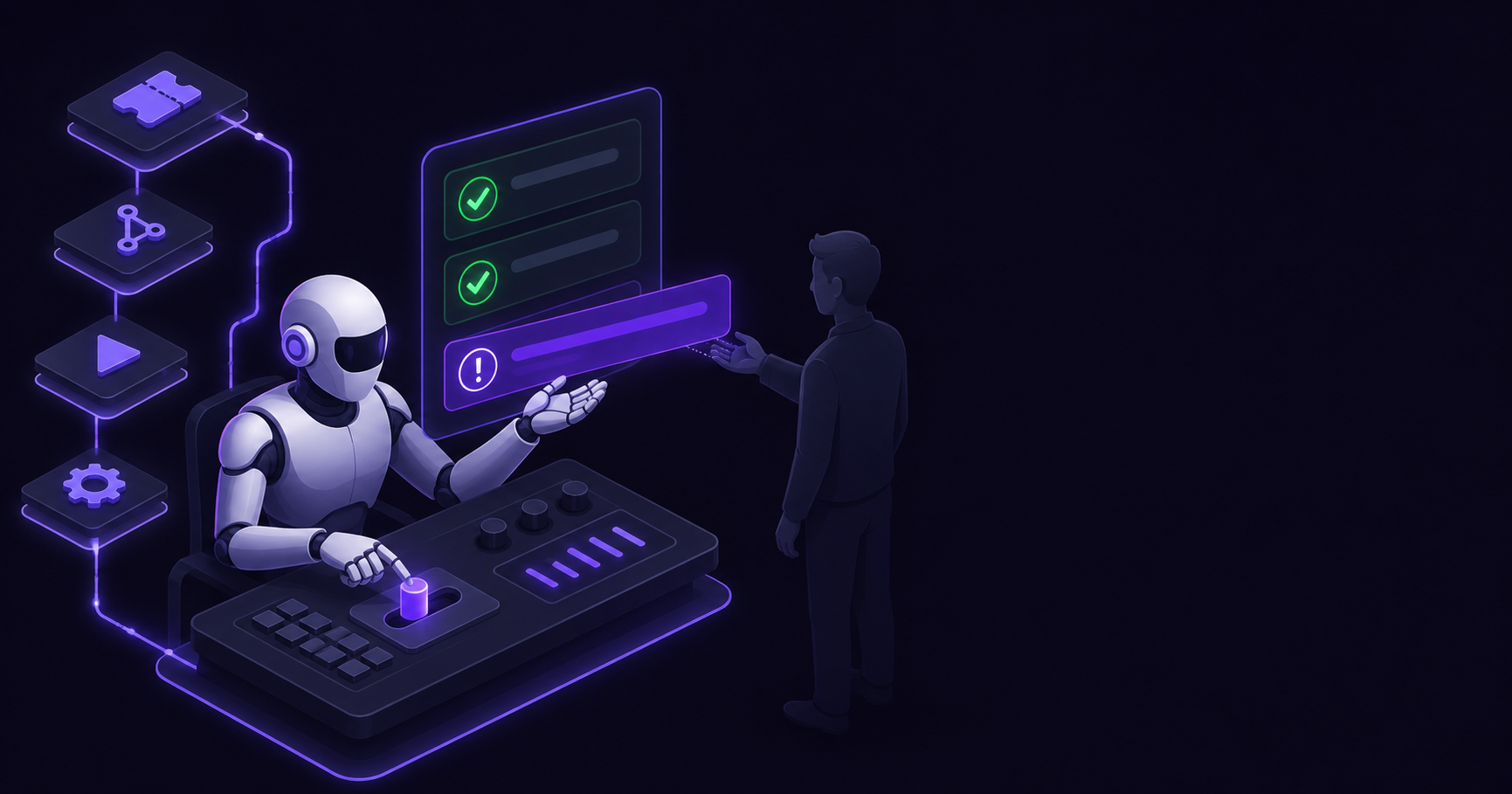
Autonomous regression testing with AI agents means an AI system decides which regression tests to run, executes them, and tells you whether a failure is a real bug or noise, without a human writing or maintaining the test scripts. In 2026 that is genuinely happening for narrow, well-scoped tasks: self-healing selectors, flaky-test classification, and agents that run suites between CI/CD triggers without a person kicking them off. What is not happening yet is full autonomy, an agent that owns your regression strategy end to end with no review step. Gartner's own 2026 numbers back that gap up, and QA Madness builds AI Agent Flows around it rather than pretending it does not exist.
Two different things hide behind this phrase
Before going further, it's worth separating two questions that both get called "autonomous regression testing with AI agents" but point in opposite directions.
The first, and the one this article is about, is using AI agents to run regression tests against your application. An agent watches for code changes, decides what to re-test, executes the suite, and triages the results. This is what a TMS, an execution framework, and an agent orchestration layer work together to deliver.
The second is regression testing the AI agents themselves, or the code that AI coding agents write. As coding assistants merge pull requests at a pace no human reviewer can keep up with, teams are building separate tooling to verify that agent-written code hasn't broken existing behavior, and to verify that an agent's own decision-making hasn't drifted after a prompt or model change. That's a real and fast-growing area, but it's a different problem with different tools (behavioral fingerprinting, stochastic pass/fail verdicts, prompt regression suites) and it's out of scope here. If your team is shipping its own AI agents and needs to test the agents themselves rather than test your product with an agent's help, that's worth a separate conversation with your automation team.
What "autonomous" means once you strip out the marketing
Every vendor page uses "autonomous" differently, so it's worth pinning down before comparing tools. Three levels show up in practice:
- Assisted: the agent suggests a test case, a fix, or a priority order; a person clicks approve. This is where most shipped AI-in-QA features sit today, including test-case generation and duplicate detection.
- Supervised autonomy: the agent runs the suite and makes small decisions (retry a flaky test, skip a known-broken one) on its own, then hands a human a triaged report before anything ships. This is where regression-specific agents have made real progress.
- Full autonomy: the agent decides what "done" means for a release with no review step. Vendors market this heavily. Almost nobody runs production regression suites this way yet, and the more careful vendor documentation says so directly.
Most of what gets called "autonomous regression testing" in 2026 is supervised autonomy: an agent handles the repetitive, high-volume parts of a regression run, and a QA engineer keeps the sign-off on anything that matters.
The gap between hype and adoption
The numbers explain why the caution is warranted. Gartner's 2026 CIO and Technology Executive Survey found that only 17% of organizations have deployed AI agents so far, even though more than 60% expect to within two years, the most aggressive adoption curve of any technology in that survey. Gartner has separately warned that over 40% of agentic AI projects will be canceled by the end of 2027, citing cost overruns, unclear business value, and weak risk controls as the recurring causes. Gartner's 2026 Hype Cycle for Agentic AI places agent development platforms at the Peak of Inflated Expectations, with market interest already above 50% penetration but the underlying technology still rated as Emerging, meaning buyers are moving faster than the products they're buying.
The market-size numbers tell the same story from a different angle. Mordor Intelligence puts the global software testing market at roughly $54.44 billion in 2026, growing to about $99.94 billion by 2031, with AI-led testing cited as a primary driver. The broader agentic AI market specifically is estimated at close to $9.89 billion in 2026, projected to reach $57.42 billion by 2031, a 42% compound growth rate. Money is moving into this category fast. That doesn't mean every dollar buys a tool that works unsupervised; the World Quality Report separately found around 45% of QA teams already use AI in some form, up from about 22% a couple of years earlier, so adoption is real, it's just earlier and narrower than the "AI agent replaces your QA team" pitch implies.
That combination, fast adoption plus a high project-cancellation rate, points to a specific failure mode: a team buys an agent expecting full autonomy, discovers it can't be trusted unsupervised on a production regression suite, and either scales it back to a narrower job or drops the project entirely. Scoping the agent's authority correctly from day one is what avoids that outcome, and it's the same lesson multi-agent orchestration platforms are learning outside of QA: agents work best with a defined, bounded task and a clear handoff point back to a human.
What AI agents already do well in regression testing
Self-healing test scripts
Traditional regression suites break every time a selector, class name, or DOM structure changes, even when the underlying feature still works. Self-healing agents watch for that kind of drift and update the locator automatically instead of failing the test and waiting for a person to fix it. This is the most mature agentic capability in regression testing right now, because the decision is narrow and reversible: match the element by a fallback attribute, log the change, move on. If the fallback match is wrong, the test simply fails on the next run and a human investigates, there's no silent, unrecoverable damage from getting it wrong once.
Flaky-test classification
A failure that only happens sometimes, with no clear pattern, erodes trust in the whole suite faster than almost anything else. Agents that track pass and fail history per test can separate a genuine regression (passed last run, fails consistently now) from environment noise (fails intermittently, no code change nearby) and flag only the first kind for a human to look at. That distinction, done well, is what makes a large regression suite usable instead of ignored, and it's also the reason run history matters so much: an agent with no history to compare against is just guessing at "flaky" the same way a new hire would.
Dynamic test prioritization
Instead of running the entire suite on every change, an agent can look at what code actually changed and run the regression tests most likely to be affected first, saving the full run for a nightly job or a release gate. This shortens feedback loops without cutting coverage, provided the mapping between code paths and tests stays current as the codebase evolves. Teams that skip maintaining that mapping tend to see this capability degrade quietly over months rather than fail loudly, which is worth watching for.
Autonomous execution between CI/CD triggers
Some platforms now let an agent manage regression runs independently between pipeline triggers rather than requiring a person to schedule or babysit each one. Paired with the results going somewhere durable, a test management system rather than a spreadsheet or a CI log that scrolls away and disappears, this is what turns "the agent ran some tests" into an audit trail a team can actually use for release decisions six months later.
A worked example: one pull request, five layers
The abstract description is easier to follow with a concrete run-through. Say a developer merges a pull request that changes the checkout flow.
- Product layer: the linked Jira ticket describes the change as "update shipping address validation." That's the context the agent has to work with.
- Agentic layer: an agent reads the diff and the ticket, and decides which existing regression tests touch shipping address validation, plus a couple of adjacent flows (payment, order confirmation) that share code paths.
- Management layer: the agent pulls those test cases and their run history from the TMS, so it already knows which of them have a recent flaky pattern before it runs anything.
- Execution layer: Playwright or Cypress actually runs the selected tests, capturing traces, video, and screenshots on failure.
- Pipeline layer: CI/CD gates the merge on the result, and results get pushed back into the TMS through the automation reporter, closing the loop.
If one test fails, the agent checks that test's history in the management layer: has it failed before with no related code change nearby, or is this the first failure right after a change that plausibly touches it? Only the second case gets flagged to a person as a likely real regression. The first case gets logged, quarantined if it keeps happening, and left out of the noise a QA engineer has to read through. That's the entire value of the agent in one sentence: it flags what deserves a human's attention, and the pass or fail call itself always stays with a person.
Where a human still has to sign off, and why that's not a weakness
None of the four capabilities above require the agent to decide what quality means for your product. They speed up execution and triage. The judgment calls, is this failure a real regression worth blocking a release, is this edge case worth a new test case, does this flaky pattern point to an infrastructure problem rather than a code problem, still belong to a QA engineer who knows the product.
| Decision type | Agent-safe today | Needs a human |
|---|---|---|
| Retrying a test after a transient failure | Yes | |
| Updating a broken selector to a known fallback | Yes | |
| Classifying a failure as likely flaky vs. likely real | Yes, as a suggestion | Final call |
| Deciding a release should ship despite an open failure | Yes | |
| Deciding a test case is obsolete and should be deleted | Yes | |
| Writing a new test case for a newly discovered edge case | Draft only | Review and approve |
QA Madness builds every AI feature in QAM Hub around that split deliberately: the agent proposes, a person decides. It's the same principle behind the platform's existing AI test-case generation and its AI-powered test management features, and it carries over directly to regression agents.
There's a practical reason for this beyond caution. An agent that silently reclassifies a real regression as "known flaky noise" is worse than no automation at all, because it removes the failure from anyone's view entirely, nobody re-checks something they were never told about. The fix isn't less autonomy everywhere; it's autonomy scoped to reversible, well-understood decisions, with anything ambiguous routed to a person by default.
Where an agent actually plugs into your stack
It helps to place autonomous regression testing inside the full pipeline instead of treating it as one standalone tool. Five layers, in order:
| Layer | What lives there | Role of the agent |
|---|---|---|
| Product | Jira, Linear, GitHub Issues | Source of requirements and change context |
| Agentic | An LLM-based agent (Claude or similar) | Reads the change, decides what to test or re-test |
| Management | The test management system | Stores cases, runs, history, and the human sign-off |
| Execution | Playwright, Cypress, other frameworks | Runs the actual browser or API interactions |
| Pipeline | CI/CD | Triggers runs and gates releases on the result |
The agentic layer needs a way to read from and write to the management layer, otherwise its decisions live only inside a chat transcript and disappear the moment the session ends. That's what an MCP server is for: it lets an agent like Claude query test cases, log results, and update the suite directly, instead of a person copying information back and forth by hand. See connecting Claude to your TMS via MCP for how that connection works in practice. Without that middle layer, "autonomous regression testing" is really just an execution-layer trick with no durable record, and no durable record means no audit trail when someone asks six months later why a bug shipped.
The current tool market, briefly
The category is crowded and moving fast enough that any specific feature comparison goes stale within a quarter, but the broad segmentation holds up: standalone AI-native testing agents (built to run regression suites with minimal setup) sit at one end, and TMS platforms that add agentic capabilities on top of existing test data sit at the other. Recent practitioner comparisons point mid-market teams (10 to 50 engineers) toward tools with strong integrations and enough support infrastructure to handle an agent behaving unexpectedly, and point regulated or large enterprises toward platforms with heavier governance and business-logic coverage. Visual regression specifically tends to be a separate, more specialized tool rather than a feature bolted onto a general regression agent.
The distinction that matters more than any vendor name: does the agent have access to run history before it makes a judgment call, or is it evaluating each run in isolation? A tool with no memory of past runs can do self-healing and prioritization reasonably well, but it can't reliably tell a real regression from a flaky test, because that distinction is inherently a comparison against history. That's the gap a TMS is built to close.
How this fits into QAM Hub today
QAM Hub's Quality Analyzer already does the assisted-autonomy work: it scans test cases for duplicates and vague steps and suggests fixes, with a QA engineer approving each change. Automation results from Playwright and Cypress land in the same platform through the official reporters, so pass rates, flaky-test flags, and trend data already exist before an agent gets involved. That existing data is what makes agentic regression testing useful rather than speculative: an agent needs run history to tell a real regression from noise, and QAM Hub is already collecting it by the time a regression agent would need to read it.
AI Agent Flows extend this into the regression layer directly. An agent flow can pick up a completed CI run, re-run the regression tests most affected by the change, cross-reference failures against the platform's own flaky-test history, and surface only the failures that look like genuine regressions, everything else stays logged but doesn't interrupt anyone. The report that lands in front of a QA engineer is already triaged instead of being a raw pass and fail list. Agent Flows are currently in testing ahead of general availability; teams evaluating them should confirm current status with QA Madness before planning a rollout around them, since a feature in active testing can still change before release.
A practical checklist before you trust an agent with your regression suite
- Does the agent show you its reasoning for skipping or downgrading a failure, or does it just not report it? If you can't audit the decision, you can't trust the report.
- Is there a run history for the agent to learn from? An agent making flaky-vs-real judgment calls with no prior data is guessing, no matter how confident the output sounds.
- Can a human override any autonomous decision after the fact, and is that override logged somewhere durable?
- Does the agent's output land in a system with history (a TMS, a dashboard), or does it disappear at the end of the CI job?
- What happens when the agent is wrong? A false "this is just flakiness" on a real regression is the costliest failure mode there is, so ask vendors directly how they guard against it, not just how often the agent is right.
- Who is accountable when an agent-approved release ships a regression? If the answer is "the agent," that's a governance gap, not a feature.
FAQ
Is autonomous regression testing with AI agents actually reliable in 2026?
For the narrow tasks it currently handles, self-healing selectors, flaky classification, prioritized re-runs, yes, with a human review step still in place for anything that affects a release decision. For fully unsupervised regression sign-off, no widely deployed tool does this reliably yet, and Gartner's own adoption and cancellation data reflect that gap directly.
What's the difference between AI-assisted testing and autonomous testing?
AI-assisted testing means the AI suggests something, a test case, a fix, a priority order, and a person approves it before it takes effect. Autonomous testing means the AI acts without waiting for approval, at least for narrow, defined decisions like retrying a flaky test or skipping a known-broken one. Most production regression testing in 2026 uses a mix of both rather than one exclusively.
Will AI agents replace manual QA engineers for regression testing?
Not based on where the technology stands today. Agents take over repetitive execution and triage; deciding what a failure means for the release, and what should be tested next, stays with the QA engineer. That division also matches where the World Quality Report and Gartner data both point: rising AI use inside QA workflows, not QA teams being replaced by them.
How does an AI agent connect to a test management system?
Through an API, or increasingly through an MCP server, which lets an agent like Claude read test cases and write results directly into the TMS instead of a person relaying information manually between tools. See connecting Claude to your TMS via MCP for the mechanics.
What's the difference between testing with an AI agent and testing an AI agent?
Testing with an AI agent means the agent helps run regression tests against your product, which is what this article covers. Testing an AI agent means verifying that the agent's own decision-making hasn't drifted after a prompt, tool, or model change, a separate discipline with its own methods (behavioral fingerprinting, stochastic pass and fail verdicts) that applies mainly to teams building agents rather than teams using them for QA.
What should I check before adopting an AI regression testing agent?
Whether it shows its reasoning for each decision, whether it has enough run history to make good flaky-vs-real judgment calls, whether a human can override it, and where its output ends up. See the checklist above for the full list.
Does QAM Hub support autonomous regression testing?
QAM Hub's Quality Analyzer handles AI-assisted case review today, and results from Playwright and Cypress runs already feed into the platform's automation reporting. AI Agent Flows, which apply that same triage logic directly to regression runs, are currently in testing ahead of general availability. Check current status with QA Madness before planning a rollout around them.