

How to Introduce AI Into Your QA Process Without Breaking It
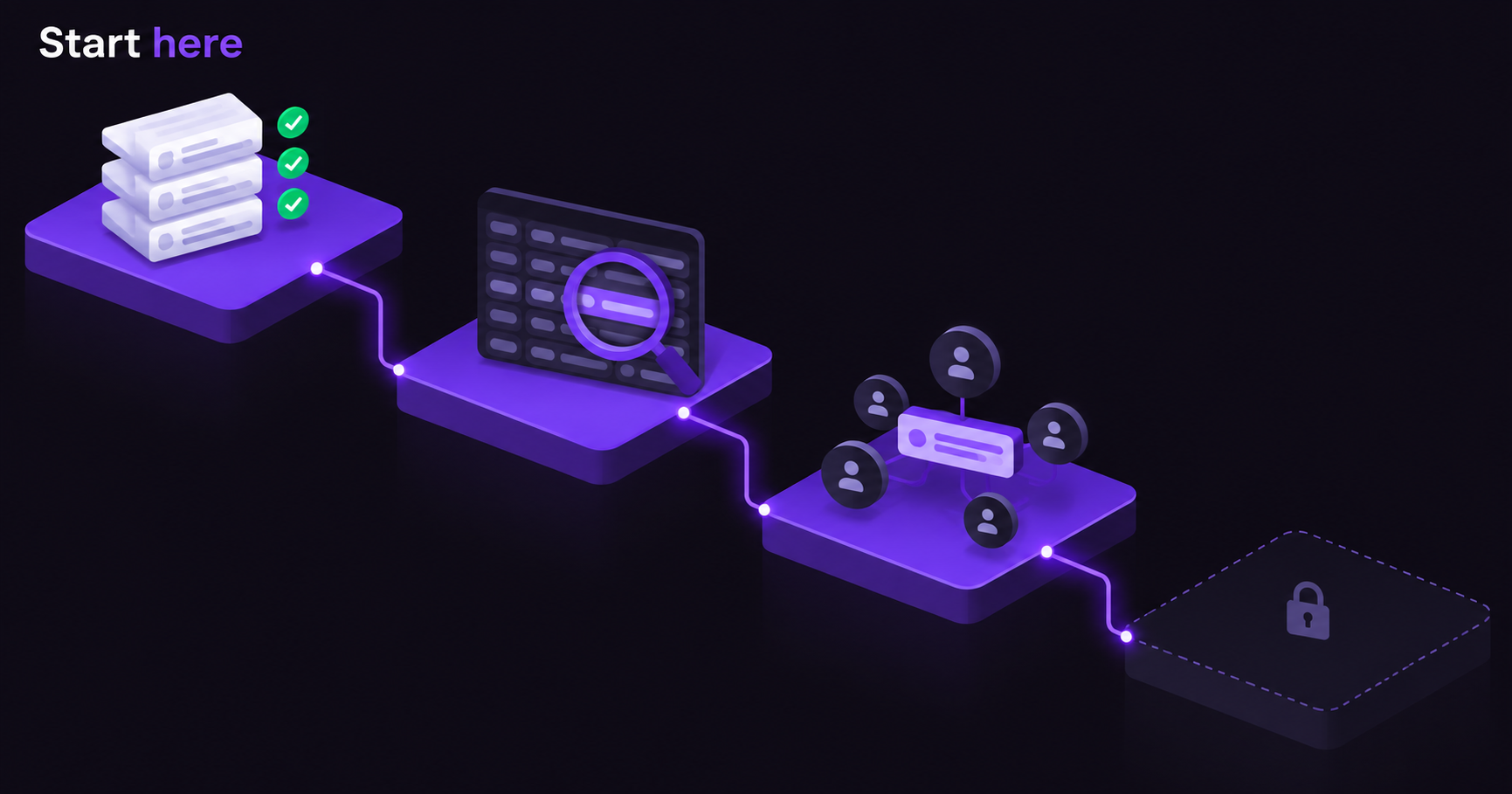
Introduce AI into QA in the order set by how cheaply a wrong answer gets caught, and the rest of the rollout mostly takes care of itself. That means starting with work where the output is reviewed the same day by someone who would have produced it anyway: first drafts of test cases against a written spec, cleanup of an existing test base, and triage of automation failures. It means holding back the work where a bad output silently becomes the standard, which is anything that decides whether behaviour is correct. A stalled QA AI programme usually has that sequence backwards. It started with autonomous execution against a system nobody had documented, and produced output nobody had the time or the standing to check.
This article is about the sequence and the process changes. The map of what the technology can and cannot do by activity is a separate piece: AI in software testing, what it can and cannot do. Read that one first if you are still deciding whether to adopt at all. This one assumes the decision is made and the question is how.
Order by reversibility, not by team maturity
Most published adoption guides sequence by maturity. Assess your current state, define goals, pilot, scale, institutionalise. That ordering is comfortable and it predicts very little, because it says nothing about which task you should hand over first. Two teams at identical maturity will get completely different outcomes depending on whether they started with case drafting or with autonomous regression runs.
A better sort key is the cost of a wrong output that nobody notices. Every AI task in QA sits somewhere on that axis:
| Task | When a wrong output surfaces | Who pays |
|---|---|---|
| Drafting a test case from a written requirement | Immediately, in review | The reviewer, in minutes |
| Flagging duplicate or stale cases in an existing suite | Immediately, per finding | The reviewer, in minutes |
| Grouping and summarising automation failures | Within the triage session | The engineer, who re-reads the trace |
| Proposing an updated expected result after a UI change | Only if someone compares it to the requirement | The next release, if wrong |
| Generating a regression suite for undocumented legacy behaviour | Possibly never | Everyone, permanently |
| Autonomous execution deciding pass or fail unattended | When a customer finds the defect | Production |
Work down that table, not up it. The first three rows are where a team gets real time back within a sprint or two and where a mistake costs one reviewer one review. The last three need controls in place first, and the fifth row is actively dangerous on a system with no specification, because generated tests then encode current behaviour as correct and a genuine bug fix starts failing the build.
The practical consequence for a budget conversation: the first phase of AI in QA does not need new headcount, a platform team, or a procurement cycle. It needs review time from people who already exist, and somewhere structured to put the output. The expensive phase comes later and it is worth reaching deliberately rather than by accident.
The three handovers worth making in the first month
Drafting cases from something already written
Generation works when the source of truth is external to the model. A user story with acceptance criteria, an API contract, a design spec, a filled-in bug report. The model reshapes material that already exists into the house test-case format, and the reviewer checks it against the same source. When there is no written source, generation produces plausible cases for a product nobody has described, and the review has nothing to check them against.
Two things break here more often than teams expect. The first is format drift: generated cases arrive with inconsistent step granularity, so one case has three steps and its sibling has fourteen. Fix that with a template and a worked example in the prompt rather than in review, or you will spend the saved time reformatting. The second is coverage bias. Models over-produce happy-path and obvious-boundary cases and under-produce the state-dependent ones, the sequences that only fail on the second attempt or after a session expires. Expect to write those yourself, and treat a generated set as the floor of the suite rather than the ceiling.
A reasonable first target is a single feature area with decent written requirements, one reviewer, and a rule that generated cases enter the suite only after review. In QAM Hub, AI generation from a description or a screenshot is on both plans and writes into the normal case structure with version history and rollback, which matters more than it sounds: the review trail and the ability to revert a bad batch are what make the first month low-risk. The KB guide on generating test cases with AI covers the mechanics.
Cleaning the suite you already have
This is the handover most teams skip and it is usually the one with the fastest payback. A test base that has grown for three or four years contains duplicates written by people who did not know a case already existed, cases for features that shipped differently, and cases nobody has executed since 2023. Finding those by hand is unpleasant enough that it never gets scheduled.
Pattern-matching across a few thousand cases is exactly the kind of work where a model is reliable, because every finding is checkable in seconds by the person who owns that area. The review is fast, the mistake is cheap, and the result is a smaller suite that runs faster and produces fewer false alarms. We wrote up the manual version of this analysis in how to find duplicate and low-quality test cases, and the automated version in QAM Hub is Quality Analyzer, which scores the test base against run history and attaches evidence quotes to each finding. It sits on the Advanced plan.
One caution. Deleting cases feels productive and is not always correct. A case that has not run in two years might be dead weight or might be the only coverage of an annual billing path. Triage into keep, merge, rewrite and retire, and make retire a reviewed decision rather than a bulk action.
Triage on automation failures
A pipeline that produces forty red tests after an overnight run costs an engineer the first hour of the morning before any fixing starts. Grouping those failures by shared cause, separating a genuine regression from an environment blip, and pointing at the trace that shows the difference is work a model does well, because the trace, the screenshot and the previous run are all in front of it and the engineer verifies the conclusion in the same screen.
The gain here is measurable in a way the other two are not, and it is the one worth instrumenting from day one. Time from run completion to a triaged, assigned failure is a number a QA lead can quote to a CTO. Test-case count is not, which is part of the argument in QA metrics that matter for engineering leaders.
Review capacity is the real constraint
Generation capacity is effectively free. Review capacity is fixed at the number of engineer-hours you have, and it does not grow because a tool got faster. A team that generates four hundred cases a week and can review sixty has not adopted AI, it has created a backlog with a quality problem attached.
So cap the input. Decide how many hours a week go into reviewing AI output, work out how many cases or findings that buys at your actual review pace, and generate that much. Measure your pace once rather than guessing it, because the first estimate is always optimistic and reviewing a generated case is a different job from writing one. Writing is generative and the reviewer holds the requirement in their head throughout. Reviewing is verification against a source that has to be re-read, and it is more tiring per unit than people predict, which is why review quality decays over a long batch.
Three process changes make review hold up:
- A written definition of done for a test case. Most teams have an implicit one. Once a model is producing candidates at volume, implicit standards stop working, because the reviewer needs something to point at when rejecting. Step granularity, what belongs in preconditions, whether expected results describe state or describe screens.
- Two reviewers on the first batches. Not forever. Long enough to find out whether the two of them agree, which is the cheapest available check on whether your definition of done is actually shared.
- A visible review state on the artefact itself. Whether a case has been reviewed, by whom, and when, stored with the case rather than in a spreadsheet next to it. This is the thing teams improvise in the first month and regret in the third.
Reviewer scepticism is a feature here rather than a problem to manage away. In Stack Overflow's 2025 developer survey of 49,009 developers, 45.7% of those answering the AI questions said they somewhat or highly distrust the accuracy of AI output, against 32.7% expressing some trust, and the most common reason given for still wanting a human in the loop was not trusting the AI's answer, at 75.3%. Almost-right output is the expensive kind, because it survives a fast skim. A review process built for obviously-wrong output will not catch it, and a reviewer who has stopped expecting errors will not either.
What not to hand over yet
Four things, and the reasoning is the same for all of them. Each is a place where the model would be writing the standard rather than being measured against one.
Authoring acceptance criteria. If AI writes the criteria and then writes the tests that check them, the tests pass by construction and mean nothing. Someone with product authority writes what correct looks like.
Risk-based prioritisation. What to test first depends on revenue exposure, regulatory consequence, which component the team distrusts, and what shipped last Thursday. A model can restate the priorities you give it and cannot derive them.
Release sign-off. A readiness summary that assembles the evidence is useful. The decision needs a name attached, for reasons that are as much organisational as technical.
Unattended execution against anything you would not roll back easily. Autonomous agent runs are worth reaching, and they need a review workflow with consequences before they are worth trusting. Autonomous regression testing with AI agents covers what that looks like in practice. In QAM Hub this is Agent Flows, which is an Advanced-plan feature and is currently marked coming soon.
Where adoption actually dies
The failure modes below come up more often than any technical limitation, and none of them is fixed by a better model.
It is already happening without you. The MIT NANDA report on enterprise AI, based on 52 structured interviews and 153 survey responses from senior leaders, found workers at over 90% of the companies surveyed regularly using personal AI tools for work while only about 40% of those companies had bought subscriptions. The report describes its own figures as directionally accurate rather than audited, so read the shape of it rather than the decimal. Engineers are pasting requirements into consumer chat tools right now. A rollout that starts by banning that will not stop it, it will only make it invisible. Start by asking what people already do, then give the same work a sanctioned path with logging and a data rule.
The output has nowhere to live. Cases generated in a chat window get pasted into a spreadsheet, then into the tracker, then abandoned. No version history, no link to the requirement, no record of who accepted what. This is the single most common way a promising pilot produces nothing durable. If the AI work does not write into the same place the rest of your test artefacts live, you have added a step rather than removed one. That argument applies to any test management system, and it is the reason QAM Hub exposes its data through an MCP server and an API rather than keeping AI features inside a chat panel. The trade-offs of letting an agent write into the suite are worked through in giving AI agents write access to your TMS.
The pilot was run on the worst codebase in the building. Choosing the legacy monolith with no documentation is a natural instinct, since that is where the pain is. It is also the hardest possible case, the one with no written source for a reviewer to check against. Pilot somewhere with decent requirements and a team that will report honestly, then take what you learned to the hard system.
Nobody owns it. Capgemini's World Quality Report 2025-26, which surveyed more than 2,000 senior executives across 22 countries, found 89% of organisations piloting or deploying generative AI in quality engineering and only 15% at enterprise-wide implementation, with 43% still experimental. It also found 50% saying their organisation lacks AI and ML expertise, 64% naming integration complexity and 67% naming data privacy risk among their top challenges. Those are not model problems. Integration, privacy and skills are all owner problems, and the gap between 89% piloting and 15% scaling is mostly the distance between an enthusiast doing it on the side and someone whose job includes it.
The measurement rewards volume. Cases generated per week is the easiest number to produce and it drives exactly the wrong behaviour. The same report puts the average self-reported productivity gain at 19%, with a third of organisations seeing minimal gains. Averages that wide usually mean the practice varies more than the tooling does.
Governance that fits on one page
Write it before the first rollout and keep it to four decisions. Anything longer will not be read by the people it governs.
What may go into a prompt. The real question is production data. Customer records, credentials, and anything under a data-processing agreement need an explicit rule, and "use your judgement" is not one. Most teams land on synthetic or masked data for prompts and a named exception process.
Which tools are sanctioned and who holds the keys. Vendor-hosted with a signed agreement, your own API key, or a model in your own environment. All three are defensible and they have very different review burdens. Write down which one you chose and why, because the next tool request will arrive in a month.
What gets logged. At minimum, which artefacts were AI-generated, who accepted them, and when. Regulated teams will need more, and everyone needs this much to answer "where did this test come from" a year later.
Who can accept. Acceptance is an authority question. Whoever can merge a generated case into the live suite is making a quality decision, and that should be as deliberate as merge rights on a repository.
Skip the AI ethics policy, the model evaluation framework and the centre of excellence for now. At the scale of a QA team introducing generation and triage, they cost more to write than they prevent.
Measuring whether it worked
Pick the measurements before the pilot, because the numbers that look good afterwards are chosen to look good. Four are worth the trouble:
- Review time per accepted artefact. The cost side of the ledger, and the one that tells you whether the cap on generation is set correctly.
- Rejection rate, and what happened to it. Falling because the prompts and templates improved is the good case. Falling because review turned into a skim is the bad one, and the two look identical on a chart, so ask the reviewers.
- Time from a failed run to a triaged, assigned failure. The clearest win in the first three months and the easiest to defend in a budget conversation.
- Escaped defects in the areas that got AI-assisted coverage. Slow, noisy, and the only one that speaks to whether quality moved. Treat it as a trailing indicator over a quarter or two rather than a sprint metric.
Two numbers to leave alone. Cases generated, for the reason above. And any productivity percentage borrowed from a vendor case study, since it describes someone else's baseline.
There is a maintenance dimension that is easy to miss when everything is going well. GitClear's analysis of 623 million changes from 2023 to 2026 found block duplication rising 81% since 2023 while the share of moved, refactored lines fell from 13% in 2023 to 3.8% year to date in 2026. That is application code and not test code, so read it as an adjacent signal rather than a measurement of your suite. The mechanism transfers though: generated artefacts accumulate faster than anyone consolidates them, and a test suite has the same failure mode. Schedule the consolidation pass, because it will not happen on its own.
A first quarter that holds up
Weeks one and two are for the boring part. Find out what people are already doing with AI, write the one-page policy, pick the feature area with the best written requirements, and measure your current review pace on a handful of hand-written cases so you have a baseline that is not a guess.
Weeks three to six, run generation on that one area with two reviewers and a hard cap on volume. Treat the test cases as a by-product. What this phase is actually producing is a written definition of done, a prompt or template that yields the right shape, and a real number for review throughput.
Weeks seven to ten, add failure triage on the automation suite, which is a different workflow with a different reviewer and will tell you whether the first result generalises. Somewhere in here, run the duplicate and staleness analysis on the existing base, because by now the team has enough calibration to triage the findings quickly.
The last stretch of the quarter is for the decision, and it is a real decision with three honest answers. Expand, hold at the current scope, or stop. Holding is underrated. A team that has generation and triage working well, with review capacity as the visible limit, is in a better position than a team that pushed into autonomous execution because the quarter had time left in it.
The real cost is review hours, and it is front-loaded
The tooling is the small line. The real cost is review hours in the first quarter, and it is front-loaded: heaviest in weeks three to six, lighter afterwards as the templates and the definition of done do more of the work. Budget it as a temporary dip in throughput from the people doing the reviewing, and say so to whoever owns the release schedule, because an unannounced dip reads as the AI making things slower.
On the tooling side, watch for pricing that meters the thing you are trying to scale. A per-credit or per-run model makes review capacity and budget fight each other, and the team ends up rationing generation for the wrong reason. In QAM Hub all AI features are included in every plan, sized so a working team does not hit a limit, subject to fair use, with the allowance growing per seat. There is no separate credit purchase, no per-credit overage and no run cap. Quality Analyzer, Release Readiness and Agent Flows sit on the Advanced plan, and generation, bug analysis and the in-app assistant are on both. The pricing page has the current plan split.
What it does not cost is headcount, at this stage. Teams that hire an AI specialist before they have a definition of done and a measured review pace tend to end up with a specialist who has nothing to be specific about.
What to do first, and what to leave
If you do one thing this quarter, cap generation at measured review capacity and write the definition of done. Everything else in this article is downstream of those two, and most stalled adoptions failed one or both of them.
Leave the tool evaluation until after the pilot. The category is moving fast enough that a decision made in month one is stale by month four, and a pilot run inside whatever you already have will tell you which capabilities you actually use. When you do evaluate, the evaluation checklist is ordered by what breaks first in a rollout.
And leave autonomous execution to a later quarter. It is the part of this that genuinely changes the economics, and it is also the part where a bad rollout costs the most trust. Reaching it with a working review process and a measured baseline is a completely different proposition from reaching it in month two with neither.
Frequently asked questions
Do we need a dedicated AI testing tool, or is a general-purpose assistant enough?
A general assistant is enough for the first handover and usually not for the second. Drafting cases from a spec works fine in a chat window, with the caveat about data in prompts. Duplicate analysis across an existing suite and triage across run history both need the tool to see the whole test base and the run record, which a chat window does not. The practical question is where the accepted output lands. If the answer involves copy and paste, the pilot will produce learning and no durable artefacts.
Who should own AI adoption in QA, the QA lead or the platform team?
The QA lead owns the definition of done, the review process and the acceptance authority, because those are quality decisions. The platform team owns keys, logging and the data rule, because those are the same problems they already solve for other tools. Adoptions that stall usually gave the whole thing to one side. A platform-owned rollout produces a sanctioned tool nobody uses in a way that changes the process, and a QA-owned rollout with no platform involvement produces a data-handling problem that surfaces at the worst moment.
How do we handle test data and credentials in prompts?
Decide it before the pilot rather than during it. Synthetic or masked data for anything that leaves your environment is the default that holds up, and it needs someone to generate that data, which is a real task and belongs in the plan. Credentials never go in a prompt, including in a pasted config file or a screenshot of one, and screenshots are the route people forget. If a specific case genuinely needs production-shaped data, that is the named exception process in the one-page policy, with a person attached to it.
Our requirements are thin. Should we wait until they improve?
No, but adjust what you expect. With thin requirements, generation output is a prompt for a conversation rather than a draft to accept, and it is most useful for finding the questions nobody asked the product owner. That is genuine value and it is not a throughput gain, so do not promise one. The one thing to avoid is generating a regression suite against undocumented legacy behaviour, which converts today's bugs into tomorrow's expected results.